
Why Your Food Diary Matters More Than Your Warfarin Dose
You take your warfarin every day at the same time. You show up for your INR checks. But your blood thinning levels keep swinging-too high one week, too low the next. You’re not alone. For many people on warfarin, the problem isn’t the pill. It’s what’s on your plate.
Warfarin works by blocking vitamin K, a nutrient your body needs to make blood clot. Too much vitamin K? Your INR drops. You’re at risk for clots. Too little? Your INR spikes. You could bleed internally. The difference between safety and danger can be as simple as eating a big bowl of spinach one day and none the next.
That’s why tracking vitamin K isn’t optional. It’s the single most effective thing you can do to keep your INR steady. Studies show patients who track their vitamin K intake spend over 70% of their time in the safe range. Those who don’t? Closer to 60%. That 10% gap? It’s the difference between living normally and ending up in the ER.
What Exactly Is Vitamin K Doing in Your Blood?
Warfarin doesn’t thin your blood. It stops your liver from using vitamin K to make clotting factors-proteins that help your blood seal cuts and prevent internal bleeding. When you eat foods rich in vitamin K, your body makes more of these clotting factors. That directly fights warfarin’s effect.
The problem? Vitamin K isn’t just in one food. It’s everywhere-and in wildly different amounts. A cup of cooked kale has over 800 micrograms. A slice of pizza? Maybe 10. A multivitamin? Could be 50. If you don’t track it, your intake jumps around. And every jump sends your INR off balance.
Doctors don’t tell you to avoid vitamin K. They tell you to keep it steady. The American Heart Association says consistency beats quantity. Eating 120 mcg every day is safer than eating 300 one day and 20 the next-even if your average is the same. Your body needs predictability, not perfection.
What Foods Are High in Vitamin K? (And What’s Hidden)
Leafy greens are the big ones. But it’s not just kale and spinach. Here’s what actually moves the needle:
- Cooked kale: 817 mcg per cup
- Cooked spinach: 483 mcg per cup
- Cooked broccoli: 220 mcg per cup
- Raw romaine lettuce: 138 mcg per 2 cups
- Soybean oil, canola oil: 20-30 mcg per tablespoon
- Fortified meal replacements (like Ensure): 25 mcg per 8 oz
- Green tea, natto (fermented soy): also high
But here’s what catches people off guard: processed foods. Salad dressings, frozen meals, protein bars-they often use soybean or canola oil. One day you eat a sandwich with mayo made from soybean oil. The next day you eat grilled chicken with olive oil. Your vitamin K intake changes without you even realizing it.
And don’t forget multivitamins. Many contain 25-100 mcg of vitamin K. If you take them on some days and skip others, your INR will react. The fix? Take them the same way every day-preferably with your warfarin.
Paper Diaries vs. Apps: Which One Actually Works?
You can track vitamin K on paper or on your phone. Both work-but one is better for most people.
Paper diaries are simple. You write down what you ate, the portion, and your INR. They’re free, no batteries needed, and 82% of seniors over 75 stick with them. But they’re easy to lose, smudge, or forget. One patient told me his diary got soaked in his pocket. Two weeks of data gone.
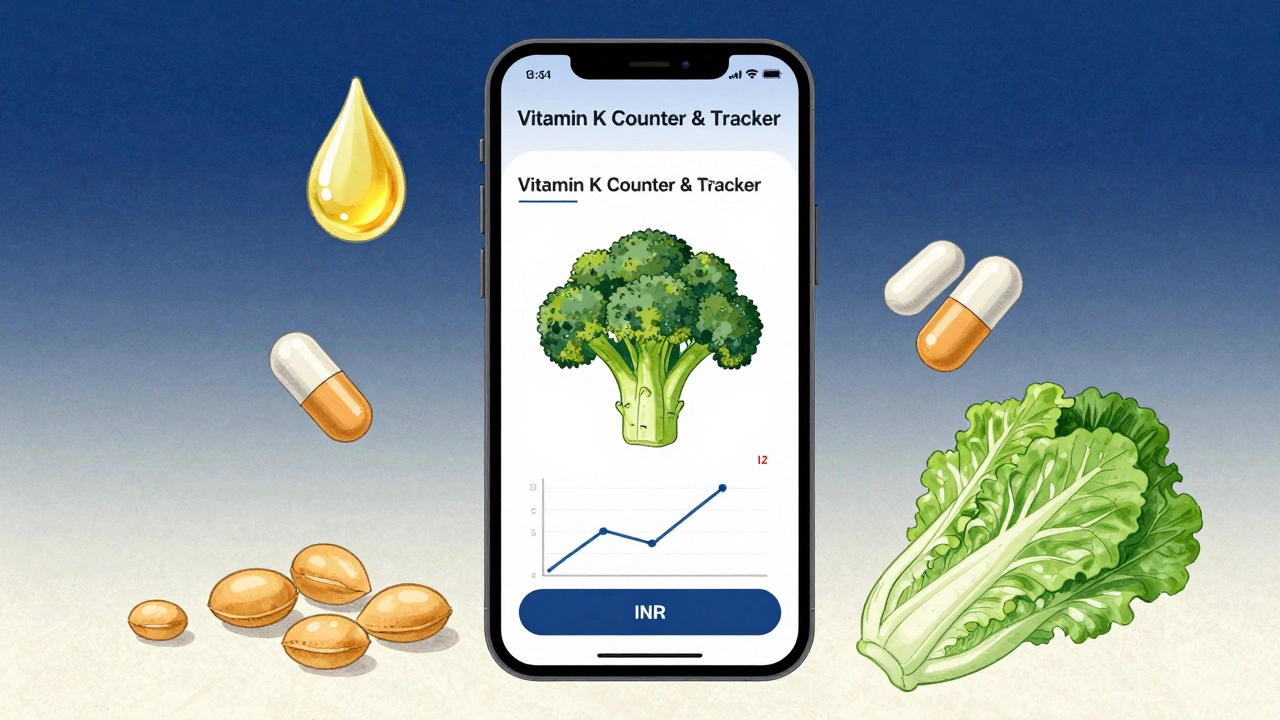
Digital apps are smarter. The Vitamin K Counter & Tracker app (iOS, $2.99 one-time fee) lets you scan foods from a database of over 1,200 items. It shows you daily totals, trends, and even flags when you’ve eaten a high-vitamin K meal. A 2022 study found users of this app spent 72% of their time in the safe INR range. Paper users? Only 62%.
But not all apps are equal. Out of 27 vitamin K apps tested, only 3 had verified accuracy. The Vitamin K-iNutrient app scored 94.7% accuracy in lab tests. Free apps? Some were off by over 30%. That’s dangerous. If your app says a serving of broccoli has 50 mcg but it’s really 200, your INR will crash.
For most people under 65, an app is the better choice. For older adults or those uncomfortable with tech, paper works fine-as long as you’re consistent and honest.
How to Actually Use a Food Diary (Without Going Crazy)
Tracking your food doesn’t mean logging every bite. It means tracking the big stuff. Here’s how to do it right:
- Focus on the top 10 foods that spike vitamin K. That’s kale, spinach, broccoli, Brussels sprouts, soybean oil, and fortified drinks.
- Use visual portion guides. A cup of cooked greens is about the size of a baseball. Two cups of raw lettuce? A tennis ball. Your clinic can give you these.
- Track only once a day. Don’t stress about snacks. Just note your main meals.
- Write down multivitamins and supplements. Include the brand and dose.
- Take your diary to every INR check. Don’t wait until your appointment to remember what you ate.
Don’t try to be perfect. Aim for consistency. If you eat spinach every Tuesday and Thursday, that’s fine. Just don’t suddenly switch to kale on Wednesdays and skip it on Fridays.
And if you’re planning a big change-like a juice cleanse or a vegan month-talk to your anticoagulation clinic first. A sudden drop in vitamin K can send your INR through the roof.
What Experts Say (And Why They’re Not Just Giving Generic Advice)
Doctors don’t push food diaries because they’re trendy. They do it because the data is clear.
Dr. Gary Raskob, who helped write the American Society of Hematology guidelines, says: “The most important advice for patients on warfarin is to maintain their usual dietary pattern.” Translation: Don’t change your diet. Just keep it the same.
And it’s not just about greens. A 2021 study found patients who ate 150 mcg of vitamin K every day had 18% fewer INR swings than those who ate the same average amount but varied daily. Consistency beats averages.
The Agency for Healthcare Research and Quality reviewed 17 studies and found that structured food tracking raised time in therapeutic range by over 8 percentage points. That’s not a small win. That’s the difference between a stable life and repeated hospital visits.
And here’s the kicker: 32% of warfarin-related ER visits are tied to vitamin K swings. That’s over 100,000 trips a year in the U.S. alone. Most of them are preventable.

Common Mistakes (And How to Avoid Them)
Even people who track their food make the same mistakes:
- Underreporting: Studies show people miss 22-37% of their vitamin K intake. Hidden oils in dressings, sauces, and baked goods are the usual culprits.
- Guessing portions: A “handful” of spinach isn’t a cup. You need to measure. Use measuring cups or a food scale for the first few weeks.
- Ignoring supplements: Multivitamins, fish oil, and herbal blends can all contain vitamin K. Write them down.
- Only tracking when INR is off: If you only log when things go wrong, you’re missing patterns. Track every day-even when your INR is perfect.
Fix this by doing a “spot check.” Once a month, write down everything you ate for 24 hours. Then bring it to your dietitian. They’ll compare it to your log and show you what you missed. That alone can improve accuracy by 28%.
What’s Next? AI, Apps, and the Future of Warfarin Tracking
The field is changing fast. In January 2024, the FDA approved the first AI-powered system that takes a photo of your food and estimates vitamin K content with 89% accuracy. It’s called NutriKare. It’s not in clinics yet, but it’s coming.
Electronic health records like Epic’s MyChart now include vitamin K tracking tools. Soon, your food log might automatically adjust your warfarin dose based on trends.
But for now, the best tool is still the one you use every day. Whether it’s a notebook in your drawer or an app on your phone, the goal is the same: make your vitamin K intake predictable. That’s how you stay out of the hospital. That’s how you live without fear.
Start Today. Your INR Will Thank You.
You don’t need to become a nutritionist. You don’t need to memorize micrograms. Just pick one method-paper or app-and stick with it. Track the big sources. Be honest. Be consistent.
One patient on Reddit said it best: “Using the app cut my INR swings from monthly to quarterly.” That’s not magic. That’s data. That’s control.
Warfarin is a powerful drug. But your food diary? It’s your silent partner. Use it right, and you’re not just managing your medication. You’re managing your life.

Darren Ramowski
My name is Calem Goodridge, and I am a pharmaceutical expert with a passion for educating others about medication and diseases. I have dedicated my career to researching and developing life-changing medical treatments. In my spare time, I enjoy writing articles and sharing my knowledge with the general public to help them make informed healthcare decisions. I am also an advocate for safe medication practices and believe that patient education is key to preventing adverse drug events. With my extensive experience in the pharmaceutical industry, I strive to make a positive impact on the lives of others through my writing.
Just want to say this is one of the clearest, most practical guides I’ve read on warfarin and diet. So many people think it’s about avoiding greens, but it’s all about consistency. I’ve been on warfarin for 7 years and started tracking with an app last year-my INR has been rock solid since. No more panic calls to the clinic. Just a daily log and a deep breath.
As a clinical pharmacist who specializes in anticoagulation, I can’t stress this enough: vitamin K variability is the #1 modifiable risk factor for INR instability. Patients who track daily with even basic tools see a 30-40% reduction in supratherapeutic events. The data isn’t just convincing-it’s life-saving. And yes, that $2.99 app? Worth every penny.
bro i tried the app but it kept saying my pizza had 200mcg of vit k and i was like… that’s just pepperoni and cheese?? turned out the sauce had soybean oil. mind blown. now i just avoid anything with ‘vegetable oil’ on the label. also, why do they put vit k in protein bars?? who designed this system??
oh wow. so the real villain isn’t warfarin-it’s corporate food engineering. who knew your ‘healthy’ meal prep container was quietly sabotaging your INR with canola oil? congrats, Big Salad Dressing. you win. now i have to read every ingredient label like it’s a legal contract. thanks for nothing, modern life.
One must ask: is the pursuit of INR stability not merely a surrender to the mechanistic tyranny of biomedical reductionism? We reduce the body’s intricate dance of coagulation to micrograms of phylloquinone, as if life could be quantified by a smartphone app. The soul does not clot, nor does it bleed-it simply is. Yet we measure, track, and fret. Is this wisdom… or just another cage?
Wait-so you’re telling me the government and Big Pharma don’t want you to know that vitamin K tracking can prevent 100,000 ER visits a year? And that the FDA approved AI food scanning tech but it’s not in clinics yet? Classic. They’re milking the warfarin market while you’re stuck guessing if your kale salad is a blood clot waiting to happen. 🤔👁️
So let me get this straight: I can eat 10 cups of spinach if I do it every damn day, but if I eat 1 cup one day and skip the next? I’m a walking hemorrhage? That’s like saying breathing is fine if you do it 12 times per minute, but if you breathe 10 one minute and 14 the next, you die. This system is insane. Who thought this up? A robot?
While the foregoing exposition is undoubtedly thorough and replete with empirical substantiation, one cannot help but observe the conspicuous absence of any reference to the potential confounding influence of gut microbiota on vitamin K bioavailability. As the intestinal flora synthesise menaquinones, the dietary intake metric may, in certain individuals, prove an inadequate proxy for systemic exposure. A more nuanced approach, perhaps incorporating faecal biomarkers, may yet be warranted.