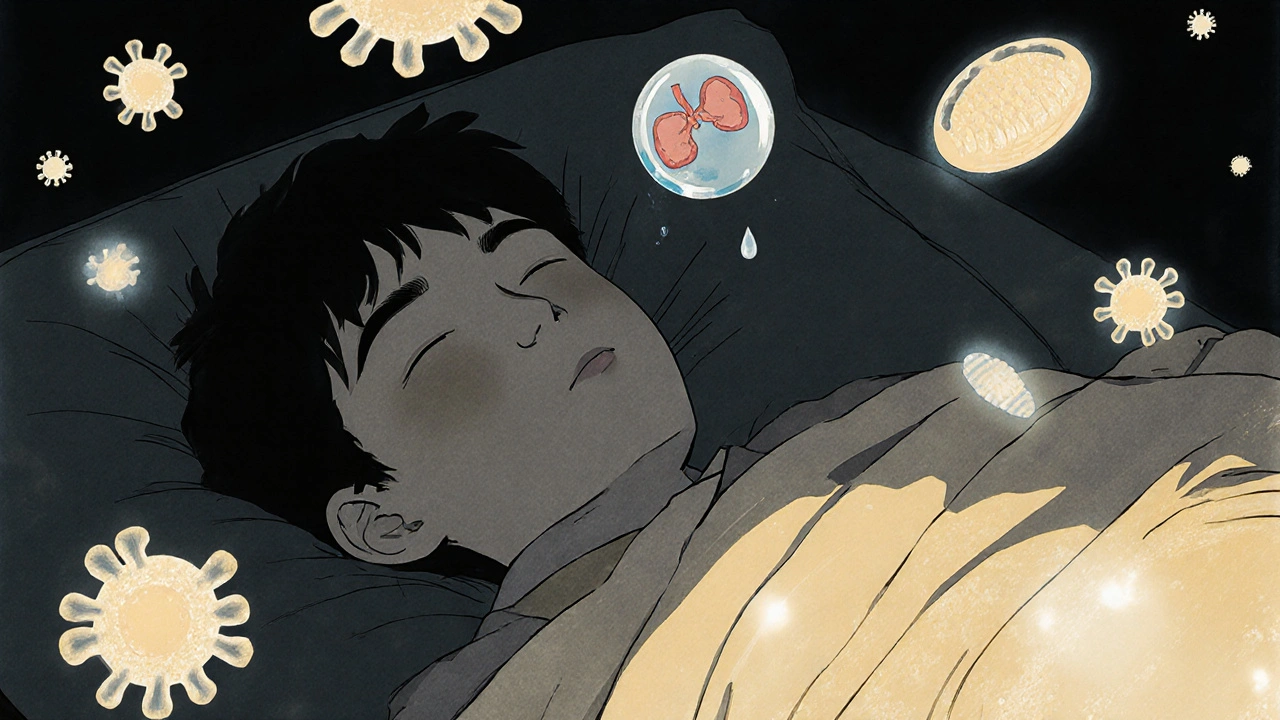
Most people think mono is just a bad sore throat that lasts a few weeks. But if you’ve had it, you know it’s more like your body got hit by a truck-and the truck didn’t leave for months. Mononucleosis, often called mono, isn’t just a virus. It’s a full-system shutdown triggered by the Epstein-Barr virus (EBV), and the fatigue? That’s not laziness. It’s your immune system fighting a silent war inside your cells.
What Exactly Is the Epstein-Barr Virus?
EBV is one of the most common human viruses on the planet. Around 95% of adults in the U.S. have been infected by age 35, and most never even knew it. In kids, it often looks like a mild cold. But in teens and young adults, it flips the script. That’s when it turns into infectious mononucleosis-what doctors call mono.
EBV is a herpesvirus, which means once it’s in your body, it never truly leaves. It hides in your B-cells, the same immune cells that make antibodies. It goes quiet, but it’s still there. For most people, that’s fine. But in the first few weeks after infection, it wakes up, multiplies, and triggers a massive immune response. That’s when symptoms hit.
It spreads through saliva-kissing, sharing drinks, toothbrushes, even coughs. That’s why it’s nicknamed the “kissing disease.” But you don’t need to be making out to catch it. A sip from a friend’s water bottle? That’s enough. The virus can live on surfaces for hours, and you can spread it even before you feel sick. The incubation period? Four to six weeks. So if you felt fine last month and now you’re exhausted, it’s not a coincidence.
The Symptoms: More Than Just a Sore Throat
Most people expect mono to mean a sore throat and fever. But the real story is deeper. The classic trio is fever, swollen glands, and a sore throat-but fatigue? That’s the silent killer. Studies show 98% of people with mono report extreme exhaustion. Not tired. Exhausted. You can’t get out of bed. Showering feels like running a marathon. Your brain feels foggy. This isn’t normal tiredness. This is your body using every ounce of energy just to keep the virus in check.
Other common signs:
- Swollen lymph nodes, especially in the neck
- White patches on tonsils (often mistaken for strep)
- Fever between 101°F and 104°F
- Muscle aches and headaches
- Loss of appetite
Here’s the tricky part: if you’re given antibiotics like amoxicillin or ampicillin-which some doctors still do-you’ll likely break out in a full-body rash. That’s not an allergy. It’s a known reaction to EBV. And it’s a red flag that you’ve been misdiagnosed.
One in two people with mono develop an enlarged spleen. That’s not just a footnote-it’s dangerous. A ruptured spleen is rare, but it’s life-threatening. It usually happens between weeks 2 and 4, often during physical activity. That’s why doctors tell you to skip sports, lifting, even roughhousing. No exceptions.
Why Recovery Takes So Long
Most viral infections clear in 7-14 days. Mono doesn’t. Symptoms can last 2-6 weeks. Fatigue? That can drag on for 2-4 months. Why?
It’s not that the virus is still active. In most cases, it’s gone quiet again. But your immune system stays on high alert. Your body is still producing inflammatory signals, even after the virus is under control. Studies show elevated levels of IL-10-a cytokine linked to fatigue-can predict who will struggle for months. If your IL-10 stays high after 6 weeks, you’re at 80% risk of prolonged exhaustion.
And here’s what most doctors don’t tell you: your energy levels aren’t linear. You might feel okay at week 3, then crash hard at week 5. That’s normal. Your body is still healing. Pushing through leads to setbacks. Rest isn’t optional-it’s part of the treatment.
Real people share this on forums like Reddit’s r/mononucleosis. One user wrote: “I thought I was recovered at week 3. Then I tried to go to class and just sat there crying because I couldn’t stay awake. It took 11 weeks to go back to part-time work.” That’s not rare. It’s typical.
How It’s Diagnosed (And Why You Might Be Misdiagnosed)
Doctors often mistake mono for strep throat. Why? Because the throat looks the same. But strep responds to antibiotics. Mono doesn’t. And if you get antibiotics anyway? You get a rash.
The standard test is the Monospot test, which looks for heterophile antibodies. It’s 85% accurate by week 2-but only 50% accurate in the first week. That means if you test too early, you might get a false negative. That’s why some people are sent home thinking it’s just a cold… only to crash later.
For confirmation, doctors use EBV-specific antibody panels:
- VCA-IgM: Positive in early infection
- VCA-IgG: Shows past infection (lasts forever)
- EBNA: Appears after 2-3 months, means you’re past the acute phase
These tests tell the full story. But many clinics still rely only on Monospot. If you’re still tired after 4 weeks and your test was negative early on, ask for the full panel.
What Actually Helps (And What Doesn’t)
There’s no cure for mono. No antiviral drug makes it go away faster. Acyclovir? It might reduce viral shedding in lab studies, but the Infectious Diseases Society of America says it doesn’t change how you feel. Steroids? They might shrink your tonsils for 12 hours, but they come with side effects like mood swings and high blood sugar. The American Academy of Pediatrics says they’re not worth it for routine cases.
So what works?
- Rest: Not “take it easy.” Full rest. No gym, no late nights, no scrolling for hours. Your body needs every resource to heal.
- Hydration: Water, broth, electrolytes. Dehydration makes fatigue worse.
- Pain relief: Acetaminophen for fever and pain. Avoid NSAIDs like ibuprofen-they can increase bleeding risk if you have low platelets (which happens in 10-15% of cases).
- Pacing: The “Pacing, Prioritizing, Planning” method works. Start at 50% of your pre-illness energy. Do 20 minutes of light activity, then rest 20 minutes. Drink 20 ounces of water. Repeat. That’s the 20-20-20 rule many students swear by.
- Gradual return: Don’t jump back into work or school full-time. Increase activity by 10% per week-only if you don’t feel worse.
And no, you can’t “push through.” That’s how you end up in the hospital.
When to Worry: Red Flags
Mono is usually harmless. But watch for these signs:
- Sudden, sharp pain in the upper left side of your abdomen-that’s your spleen. Go to the ER.
- Severe difficulty swallowing or breathing-swollen tonsils can block your airway.
- Yellow skin or eyes-sign of liver involvement (jaundice).
- Numbness, tingling, or weakness in limbs-could signal Guillain-Barré syndrome, a rare nerve complication.
If you’re dizzy, confused, or having trouble walking, don’t wait. Call your doctor immediately.
Long-Term Risks and New Research
Here’s the part no one talks about enough: mono might change your health long after you feel better.
A 2022 Harvard study of 10 million people found that having mono raises your risk of multiple sclerosis (MS) by 1.3 times. That sounds scary-but remember, MS is still rare. Your absolute risk goes from 0.02% to 0.03%. It’s a link, not a guarantee.
But here’s the exciting part: researchers are now targeting EBV to treat MS. A new antibody called atrasentan, tested in 2023, reduced new MS lesions by 60% in early trials. That’s huge. It suggests EBV isn’t just a nuisance-it’s a key player in autoimmune disease.
Moderna is also testing an mRNA vaccine for EBV. Early results show 92% of people developed protective antibodies. If it works, it could prevent mono and maybe even reduce future MS cases.
And for those with long-term fatigue, low-dose naltrexone (LDN) is showing promise. A 2023 University of Toronto study found it cut fatigue by 40% compared to placebo in people still struggling after 6 months.
Recovery Isn’t a Race
Everyone wants to know: “How long until I’m back to normal?” The truth? It’s different for everyone. Some bounce back in 6 weeks. Others take 6 months. There’s no shortcut.
The biggest mistake? Trying to return too fast. College students who go back to classes too soon often end up dropping courses. Athletes who rush back into sports risk spleen rupture. Parents who push through to care for kids end up hospitalized.
Listen to your body. Track your energy. Don’t compare yourself to how you were before. You’re not broken-you’re healing. And healing takes time.
Mononucleosis isn’t just a virus. It’s a lesson in patience. Your body didn’t fail you. It did exactly what it was built to do: fight back. Now, it just needs you to let it rest.
Can you get mono more than once?
Once you’ve had mono from Epstein-Barr virus, you won’t get the same illness again. But the virus stays in your body for life and can reactivate without causing symptoms. In rare cases, especially with a weakened immune system, reactivation might cause mild symptoms-but it’s not the same as getting mono a second time.
Is mono contagious after symptoms go away?
Yes. Even after you feel fine, EBV can still be present in your saliva for months-or even years. You can pass it to others through kissing, sharing drinks, or utensils. Most people are exposed early in life, so the risk to others is low unless they’ve never had EBV. But if you’re around someone with a weak immune system, avoid close contact until your doctor says it’s safe.
Why do some people get mono and others don’t?
It’s not about being “strong” or “weak.” It’s about age and immune response. Kids often get EBV without symptoms. Teens and young adults are more likely to develop full-blown mono because their immune systems react more strongly to the virus. If you were exposed as a child, you probably had no signs. If you were exposed at 18, your body fought harder-and that’s what caused the fatigue, fever, and sore throat.
Can mono cause long-term fatigue or chronic fatigue syndrome?
Some people do develop prolonged fatigue lasting beyond 6 months. While this isn’t the same as chronic fatigue syndrome (ME/CFS), research suggests EBV may trigger it in a small number of cases. If fatigue lasts longer than 6 months and isn’t explained by other causes, see a specialist. New treatments like low-dose naltrexone are being studied and show promise for this group.
Should I avoid alcohol after having mono?
Yes. EBV can affect your liver, and alcohol puts extra stress on it. Even if your liver tests look normal, it’s still healing. Wait at least 4-6 weeks after symptoms disappear before drinking. Some doctors recommend avoiding alcohol for 3 months, especially if you had jaundice or elevated liver enzymes.
Can I exercise after mono?
No contact sports for at least 4 weeks-and only after an ultrasound confirms your spleen has returned to normal size. Light walking or stretching is okay once your fever is gone and you’re not dizzy. But don’t rush. Return to full activity slowly. Increase by 10% per week. If you feel worse, stop. Your spleen is fragile for months.
Is there a vaccine for mono?
Not yet, but one is in development. Moderna’s mRNA-1189 vaccine, which targets EBV, entered Phase I trials in April 2023 and showed 92% seroconversion in early participants. If successful, it could prevent mono and possibly reduce the risk of EBV-linked conditions like MS in the future.
What Comes Next
If you’re recovering from mono, your next steps are simple: rest, hydrate, track your energy, and listen to your body. Don’t let anyone tell you it’s “just a virus.” It’s a major event in your immune history. And how you handle recovery now will shape how you feel months from now.
For students, athletes, and working adults, the hardest part isn’t the illness-it’s the pressure to return too soon. But the truth is, you don’t have to prove anything. Your health is the priority. Take the time. Your future self will thank you.

Darren Ramowski
My name is Calem Goodridge, and I am a pharmaceutical expert with a passion for educating others about medication and diseases. I have dedicated my career to researching and developing life-changing medical treatments. In my spare time, I enjoy writing articles and sharing my knowledge with the general public to help them make informed healthcare decisions. I am also an advocate for safe medication practices and believe that patient education is key to preventing adverse drug events. With my extensive experience in the pharmaceutical industry, I strive to make a positive impact on the lives of others through my writing.
Let me be clear: this is not a cold. It's not a flu. It's a systemic immune override that your body has no business recovering from in under six weeks. Doctors treat it like a minor inconvenience because they don't understand immunology. They hand out ibuprofen and tell you to drink tea. Meanwhile, your B-cells are locked in a civil war inside your bone marrow.
Been there. Did the 11-week recovery. Still can't believe how many people told me to 'just push through.' 😑
The real tragedy isn't the virus-it's the cultural delusion that rest is weakness. We glorify burnout like it's a virtue. We wear exhaustion like a medal. But mono doesn't care about your productivity metrics or your LinkedIn posts about 'hustle culture.' Your body isn't a machine you can reboot with caffeine and willpower. It's a living ecosystem that evolved over millions of years to survive threats like this-and it knows exactly what it's doing when it shuts you down. You're not lazy. You're not broken. You're being protected by an ancient intelligence older than capitalism, older than smartphones, older than language itself. The only way to honor that is to lie still. To stop measuring your worth in output. To let your cells do the work they were designed to do-without interference. The world will keep spinning whether you're working or not. But your immune system? It won't forgive you for trying to outrun it.
you know what they dont tell u? ebv is linked to 5g and the covid vaccines. its all connected. the gov and big pharma want u weak so u keep taking meds. i had mono after my second shot. my spleen swelled and i lost 30lbs. they dont want u to know ebv is engineered. why do u think they rush the monospot test? its a trap. if u test negative early u go back to work and die. watch the documentary 'the virus that wasnt there' on youtube. its banned in 12 countries.
you americans always make everything so dramatic. in nigeria we get sick and just drink ginger tea and go to work. mono? we call it 'body tired' and we handle it. no need for all this science talk. you people think rest is a luxury. here rest is a sign of weakness. if you can't work after one week you are not a man. we have no time for your fatigue culture.
the real issue here is cytokine dysregulation amplified by modern environmental toxins-plastics, glyphosate, EMF exposure. EBV is just the trigger. Your mitochondria are fried from decades of processed food and sleep deprivation. The immune system isn't malfunctioning-it's overcompensating for systemic collapse. LDN works because it modulates glial cells and resets the hypothalamic-pituitary-adrenal axis. But you won't hear that from Big Pharma because it's cheap and off-patent. The real cure is detox, circadian reentrainment, and zero sugar. Oh, and ditch your phone after 8pm. Your melatonin is probably in a coma.
They're lying about the MS link. The CDC knows EBV is weaponized. The mRNA vaccines were designed to trigger latent herpesviruses. That's why they're pushing the EBV vaccine now-to cover their tracks. You think this is about health? It's about control. The 'long fatigue' is a manufactured condition to keep you dependent on meds and therapy. They want you to believe you're broken so you'll accept their system. Don't be fooled. This isn't medicine. It's mind control.
EBV is the ultimate ghost in the machine of human biology-a silent architect of autoimmune collapse, a herpesvirus that doesn't just infect cells, it reprograms identity. You think fatigue is just tiredness? No. It's the echo of your immune system screaming into a void that never answers. It's the ghost of your teenage self, the one who kissed someone at a party and never knew it was the moment everything changed. Your body didn't fail you-it became a cathedral of inflammation, every cytokine a hymn, every exhausted breath a psalm. And now, in the silence after the storm, you're left with a question: Who are you, now that your old self is gone? The virus didn't kill you. It resurrected you. And resurrection? It's messy. It's slow. It doesn't come with a timeline. It comes with stillness. And stillness? That's the only sacrament left.
I had mono in college. Took me 5 months to feel normal. The biggest mistake? Trying to study while still dizzy. My grades dropped, I lost my scholarship. Learned the hard way: pacing isn't optional. The 20-20-20 rule saved me. Walk 20 min, rest 20 min, drink 20 oz water. Repeat. No gym. No caffeine. No guilt. Healing isn't linear. Trust the process.
Stop romanticizing this. You're not a martyr. You're just sick. No one cares that your B-cells are 'at war.' Get rest, stop scrolling, and go to a real doctor-not Reddit. If you're still tired after 12 weeks, get a full immune panel. Stop reading conspiracy blogs. You're not special. You're just lazy with a diagnosis.
I just want to say how much I appreciate this post. I had mono two years ago and spent six months feeling like I was underwater. No one understood. My boss thought I was faking. My friends stopped asking how I was. I cried every night because I missed my old life. But slowly, with rest and zero pressure, I came back. Not to who I was-but to someone quieter, more patient. I don't rush anymore. I don't apologize for needing to sit still. If you're reading this and you're still healing-you're doing better than you think. You're not behind. You're not failing. You're becoming.
me after 3 weeks: 'i'm fine' 🏃♂️
me after 3 days of returning to work: 💀