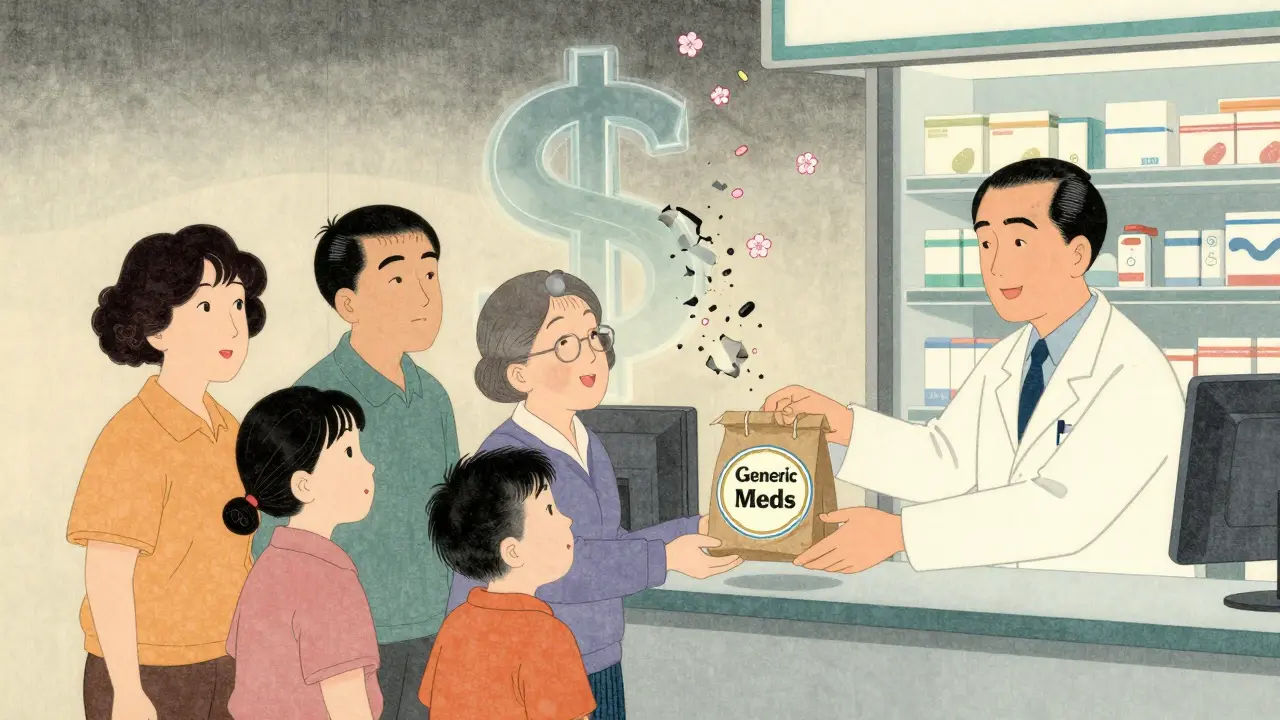
For millions of low-income Americans, Medicaid isn’t just health insurance-it’s the only thing standing between them and skipping doses because they can’t afford their meds. And the reason so many can actually fill their prescriptions? Generics. They’re not just cheaper alternatives. They’re the backbone of Medicaid’s ability to keep care affordable.
In 2023, 91% of all prescriptions filled through Medicaid were for generic drugs. That’s not a coincidence. It’s by design. These drugs work the same as brand-name versions, have the same active ingredients, and are held to the same FDA standards. But here’s the kicker: while generics made up over 9 out of every 10 prescriptions, they accounted for less than 18% of total Medicaid drug spending. That’s because they cost a fraction of the price.
How Much Do Generics Actually Save?
The numbers don’t lie. In 2023, the average copay for a generic drug under Medicaid was $6.16. For a brand-name drug? $56.12. That’s nearly nine times more. For someone living paycheck to paycheck, that difference isn’t just money-it’s whether they take their blood pressure pills, their insulin, or their asthma inhaler.
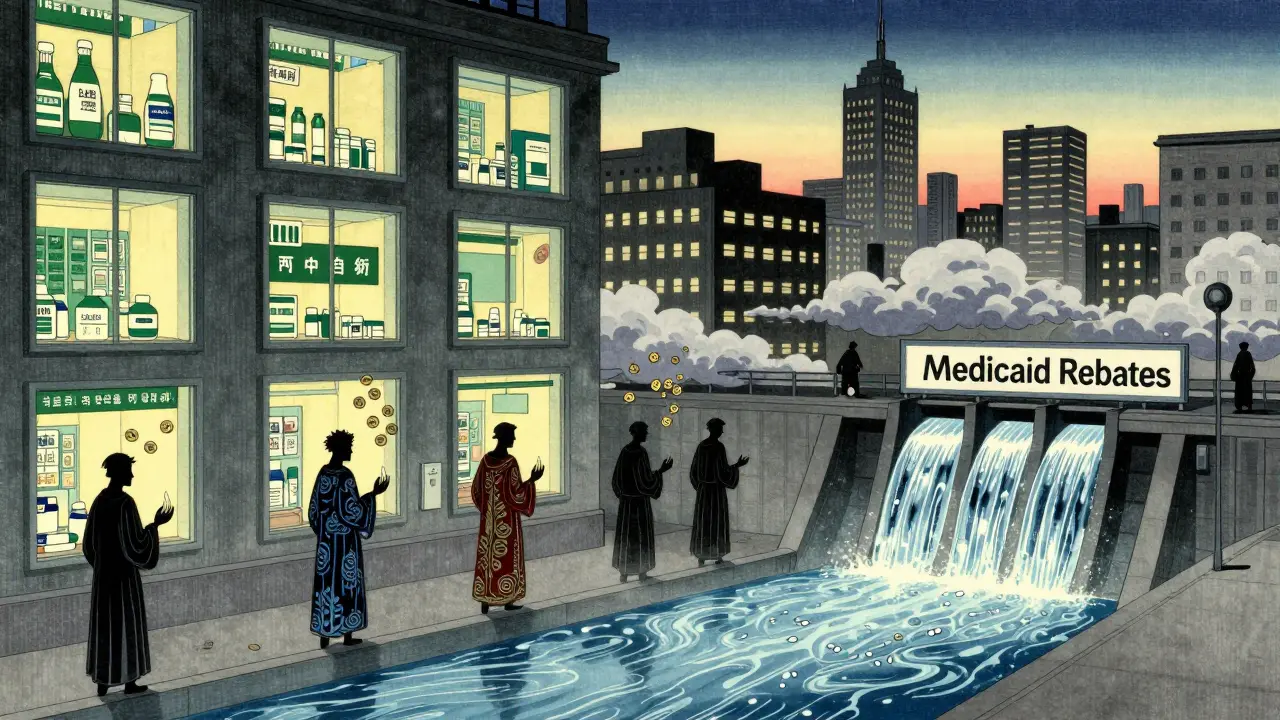
And it’s not just the patient paying less. Medicaid itself saves billions. Thanks to the Medicaid Drug Rebate Program, drug manufacturers must give states a cut of the price just to get their drugs covered. In 2023, those rebates cut Medicaid’s gross drug spending by over half-$53.7 billion saved. For every dollar spent on prescriptions, nearly 51 cents went straight back into the system because of rebates. That’s why Medicaid gets the lowest net prices of any federal health program-even lower than the Department of Veterans Affairs.
Why Generics Are So Cheap-And Why That Matters
Generic drugs don’t need to repeat expensive clinical trials. Once a brand-name drug’s patent expires, other companies can make the same medicine. That competition drives prices down. In 2022, generics saved the U.S. healthcare system $408 billion. Since 2009, that total is now over $2.9 trillion.
But here’s what most people don’t realize: Medicaid doesn’t just rely on generics. It actively pushes them. Most states automatically substitute a generic when a brand-name drug is prescribed-unless the doctor says otherwise. That means patients get the same medicine, often without even knowing they switched. And because generics are so cheap, 93% of them cost less than $20 at the pharmacy counter. Compare that to brand-name drugs, where only 59% fall under that threshold.
Where the System Still Falls Short
Even with all these savings, the system isn’t perfect. Some patients still struggle. The Georgetown Center for Children and Families found that even when generic drug prices drop, Medicaid copays don’t always follow. Some states have fixed copay tiers that haven’t changed in years. A patient might pay $10 for a generic that now costs $3 at the pharmacy. That’s money wasted.
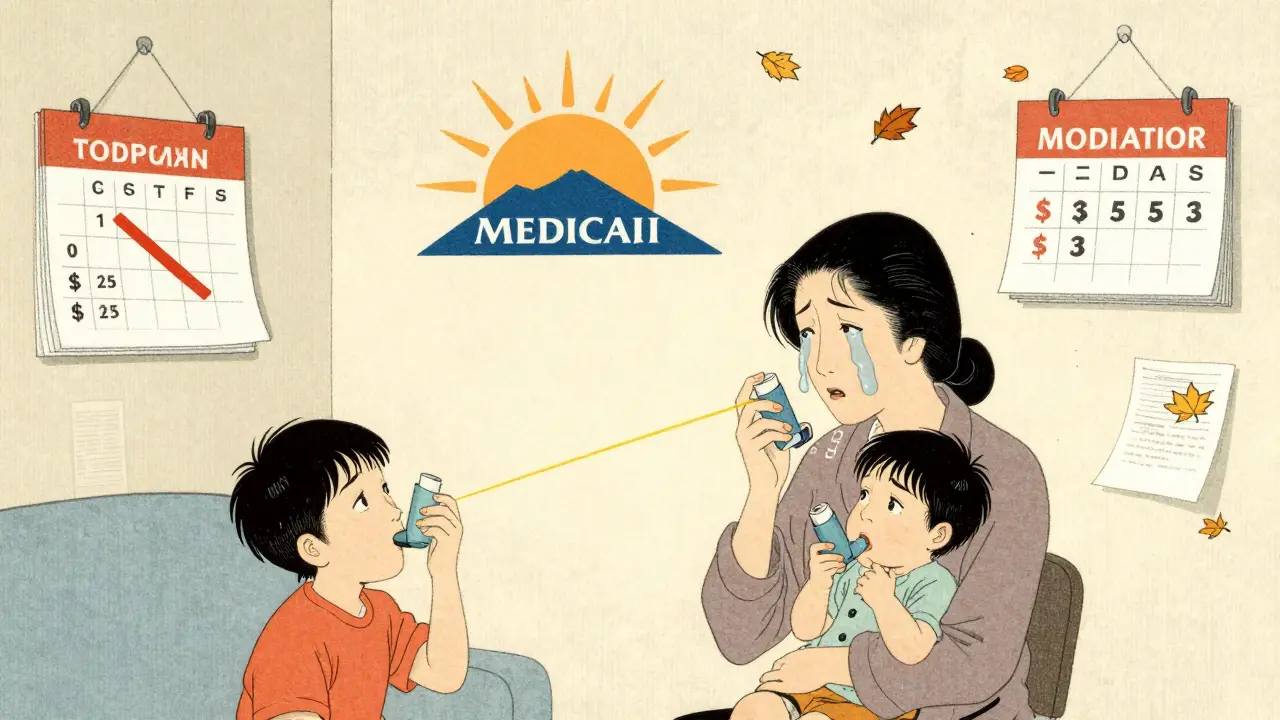
Then there’s the paperwork. One Reddit user, 'MedicaidMom2023', shared how her daughter’s asthma inhaler switched to a generic-cutting her copay from $25 to $3. But getting approval took three weeks and five phone calls. Prior authorization rules, meant to prevent overuse, often delay care. About 15-20% of all Medicaid prescriptions get held up by these rules, even for generics.
And then there are the middlemen. Pharmacy Benefit Managers (PBMs)-the companies that negotiate drug prices between insurers and pharmacies-take a cut. An Ohio audit in 2025 found PBMs collected 31% of the cost on $208 million worth of generic drugs in just one year. That’s $64 million in fees. That money doesn’t go to patients. It doesn’t go to pharmacies. It goes to corporate profits.
Specialty Drugs Are Changing the Game
Here’s the twist: while generics dominate in volume, they don’t dominate in cost. That’s because of specialty drugs. These are high-priced medications for complex conditions like cancer, MS, or rare diseases. In 2021, less than 2% of Medicaid prescriptions were for these drugs-but they made up more than half of total spending.
That’s why Medicaid’s net drug spending jumped from $30 billion in 2017 to $60 billion in 2024. Generics are still saving money. But the rising cost of a few very expensive drugs is eating into those savings. That’s why the Centers for Medicare & Medicaid Services (CMS) launched the GENEROUS Model in 2024. It’s a pilot program to redesign how Medicaid handles drug formularies, push for better pricing, and reduce waste.
What This Means for Patients
If you’re on Medicaid, here’s what you need to know:
- Always ask if a generic version is available. Even if your doctor prescribes a brand, pharmacists can switch it unless told not to.
- Know your state’s copay rules. Some states cap generic copays at $3 or $5. Others let them rise with inflation.
- Challenge prior authorization delays. If your medication is being held up, call your state’s Medicaid office. Many have patient advocates who can help.
- Don’t assume your copay is fair. If your generic drug’s price dropped but your copay didn’t, ask why. You might be overpaying.
The truth is, Medicaid’s generic drug system works better than most people think. It’s not perfect, but it’s one of the few places in U.S. healthcare where cost and access actually align. For low-income families, that’s everything.
What’s Next?
Biosimilars-generic versions of biologic drugs-are starting to enter the market. By 2027, they could save Medicaid another $100 billion a year. And if Congress extends the Medicare drug price negotiation rules to Medicaid, experts estimate an extra $15-20 billion in savings over ten years.
But none of that matters if patients can’t get their meds. The real win isn’t the rebate percentage or the copay number. It’s a mother who can fill her child’s inhaler without choosing between groceries and medicine. That’s what generics do. And that’s why they matter more than ever.
Do Medicaid patients always get the lowest price on generics?
Not always. While Medicaid negotiates bulk rebates that drive down drug prices, individual copays depend on state rules. Some states have fixed copays that don’t reflect recent price drops. In 2023, some patients paid $10 for a generic that cost the pharmacy only $3. Always ask your pharmacist if the price can be lowered.
Can I switch from a brand-name drug to a generic on Medicaid?
Yes, and in most cases, you don’t need to do anything. Pharmacies are required to substitute generics unless the prescribing doctor writes "dispense as written" or "no substitution." If you’re unsure, ask your pharmacist. They can check if a generic is available and if your state allows automatic substitution.
Why do some generics still cost so much under Medicaid?
Some generics, especially older ones with little competition, aren’t priced as low as they could be. Also, Pharmacy Benefit Managers (PBMs) often take large fees-up to 31% in some cases-before the drug reaches the pharmacy. These fees don’t always get passed on to patients, so even if the wholesale price drops, your copay might not.
Are there any drugs Medicaid won’t cover as a generic?
Medicaid must cover all medically necessary drugs, including brand-name ones if a generic isn’t available or isn’t appropriate. But if a generic exists and is equally effective, Medicaid will usually require you to use it first. Some states have exceptions for certain conditions, like epilepsy or mental health disorders, where brand-name drugs are preferred.
How does Medicaid’s generic drug pricing compare to private insurance?
Medicaid gets better prices than most private insurers because of its mandatory rebate system. In 2023, Medicaid rebates covered 61% of gross spending in fee-for-service plans. Private insurers don’t have that leverage. Even with pharmacy discount programs, private patients often pay more out of pocket for the same generic drug than Medicaid beneficiaries do.
Can I use a discount drug program like GoodRx instead of Medicaid?
You can, but it’s usually not worth it. Medicaid’s negotiated prices are already among the lowest available. A 2023 study found that for most generic drugs, GoodRx prices were only slightly lower than Medicaid copays-and sometimes higher. Plus, using GoodRx means you’re not using your Medicaid coverage, which could affect your benefits or future eligibility.

Darren Ramowski
My name is Calem Goodridge, and I am a pharmaceutical expert with a passion for educating others about medication and diseases. I have dedicated my career to researching and developing life-changing medical treatments. In my spare time, I enjoy writing articles and sharing my knowledge with the general public to help them make informed healthcare decisions. I am also an advocate for safe medication practices and believe that patient education is key to preventing adverse drug events. With my extensive experience in the pharmaceutical industry, I strive to make a positive impact on the lives of others through my writing.
Let’s be real-generics are the unsung heroes of Medicaid. I’ve seen friends choose between insulin and rent, and generics? They’re the only thing keeping them alive. The 91% stat? That’s not just numbers-that’s dignity. And yeah, PBMs are sketchy as hell, siphoning off 31% like it’s their job. But at least Medicaid forces rebates. Private insurers? They’d sell your kidneys for a 5% discount.
Also, the fact that copays don’t drop when drug prices do? That’s systemic theft. States need to tie copays to actual wholesale costs, not some 2012 spreadsheet. Fix that, and we’re halfway there.
Generics are life. 😊 I got my mom’s blood pressure med switched last year-copay went from $28 to $3. She cried. Not because she was happy (she’s stoic) but because she finally didn’t have to skip doses. Medicaid’s system ain’t perfect, but it’s the only thing standing between my family and disaster. 🙏
Oh, so now we’re told to trust ‘generics’? Hah! The FDA doesn’t test bioequivalence properly-there’s a 20% variance allowed! That’s not medicine-it’s Russian roulette with your kidneys! And who owns the patent on these generics? Big Pharma subsidiaries! They create the brand, let the patent expire, then sell the generic to themselves under a new shell corporation! It’s all a scheme! You think the rebate saves money? That money goes straight into offshore accounts! The government is lying to you! 🚨
Man, I love how this post breaks it down. I’m an RN in Texas, and I see this every day. A lady came in last week-her asthma inhaler was $40 out of pocket before Medicaid switched her to generic. Now it’s $3. She asked me, ‘Is this even the same thing?’ I said, ‘Lady, it’s the same active ingredient, same dosage, same everything. The only difference is the label and the price tag.’ She laughed and said, ‘Well, I’ll take the label.’
And yeah, PBMs? They’re the middlemen who act like they’re doing you a favor. They’re not. They’re just taking a cut. Always ask your pharmacist: ‘What’s the cash price?’ Sometimes it’s cheaper than your copay. Crazy, right?
Generics work. They’re safe. They save lives.
That’s it.
YES. YES. YES. I’ve been screaming this from the rooftops: Medicaid’s generic system is one of the few things in U.S. healthcare that actually WORKS. People act like it’s a charity, but it’s a smart, efficient system. The rebates? Genius. The automatic substitution? Brilliant. The copay lag? Yeah, that’s broken. But the foundation? Solid. Let’s fix the edges, not tear it down.
Also-stop using GoodRx. You’re not saving money. You’re just not using your benefits. And that’s dumb.
Wait, so if I’m on Medicaid and I get a generic, can I just go to CVS and pay cash and get it cheaper? I mean, I’m not trying to game the system, but if the pharmacy paid $2 for it and I’m paying $5, why not just pay $2? I’m confused. Are you telling me I can’t do that? Because I’ve seen people do it. And if I can, why isn’t everyone doing it? I need clarity. This is important.
It is, indeed, a matter of profound societal importance that the utilization of generic pharmaceutical agents within the Medicaid framework constitutes a paradigmatic example of fiscal prudence and pharmacological efficacy. The empirical data, as presented herein, demonstrate with statistical robustness that the aggregate cost-savings accrued through the implementation of generic substitution protocols exceed, by an order of magnitude, the marginal administrative expenditures incurred in the enforcement of formulary compliance. Moreover, the structural integrity of the Medicaid Drug Rebate Program, as codified under 42 U.S.C. § 1396r-8, represents a triumph of regulatory design over market-based inefficiencies. One might posit, then, that the persistent disparities in copayment structures are not indicative of systemic failure, but rather, a reflection of intergovernmental fiscal inertia-particularly in jurisdictions where legislative revision has been deferred pending fiscal recalibration. It is, therefore, incumbent upon stakeholders to advocate for dynamic, inflation-adjusted copayment tiers, lest we permit bureaucratic ossification to undermine public health outcomes.
They’re not saving you money-they’re saving the system. And who’s the system? The same ones who run the prisons, the banks, the military-industrial complex. Generics? They’re a trap. You think you’re getting a deal? No. You’re getting the leftovers. The drugs that didn’t pass clinical trials. The ones the big companies didn’t want. And you’re happy because it’s cheaper? You’re being played. The government wants you dependent. They want you to think this is a win. It’s not. It’s a slow poisoning with paperwork.
Also, PBMs? Owned by the same people who own the brand-name companies. It’s all connected. Wake up.
It is an incontrovertible fact that the Medicaid program’s reliance on generic medications constitutes the single most rational, evidence-based, and ethically sound policy initiative in the entire U.S. healthcare apparatus. The data are unambiguous: 91% of prescriptions filled are generics; 18% of total drug expenditure. The rebate mechanism is not merely effective-it is revolutionary. To suggest that copays lag behind wholesale prices is not a critique of the system, but rather, a call for administrative refinement-not dismantling. Furthermore, to equate Pharmacy Benefit Managers with predatory actors is to misunderstand the market: they are intermediaries, not villains. The real villain is the absence of universal price transparency. And yes, I’ve read the Ohio audit. And yes, I still think Medicaid is the gold standard.
One thing people miss: Medicaid’s net cost per prescription is lower than the VA’s. That’s huge. The VA has buying power, but Medicaid has leverage-mandatory rebates, mandatory substitution, mandatory price transparency. It’s not perfect, but it’s the closest thing we have to a functioning public drug program. And it’s working. Don’t fix what isn’t broken. Fix the copays. Fix the prior auth delays. But don’t throw out the system because of the glitches.
As someone from India, I’ve seen how generics work in a country where 80% of drugs are generic. We don’t have Medicaid, but we have something better-competition. Thousands of manufacturers. Prices so low, you can buy a month’s supply of metformin for $1. Here, the system works, but it’s bottlenecked by PBMs and state bureaucracy. Imagine if we had India’s scale and America’s infrastructure? We could eliminate copays entirely for generics.
Also-prior authorization for an inhaler? That’s absurd. In Delhi, you walk in, ask for the generic, pay $2, leave. No forms. No calls. No waiting. We need to borrow that model.
Generics? Pfft. You think they’re safe? Nah. I heard from my cousin who works at a pharmacy in Ohio-they get these generics from China, and the active ingredient? Sometimes it’s 60% of what it should be. They just add filler to make up the weight. And the FDA? They inspect like once every 10 years. And PBMs? They’re just middlemen who charge you extra so they can buy their third vacation home. You think this is healthcare? It’s a pyramid scheme with pills. And don’t even get me started on the 2023 study that said GoodRx is cheaper-yeah, because they’re not using Medicaid’s rebates. They’re just hiding the real cost. Wake up, sheeple!
The Medicaid Drug Rebate Program is a legally mandated mechanism designed to ensure fiscal responsibility in public drug expenditure. The statistical correlation between generic drug utilization and reduced per-capita spending is not merely coincidental-it is causally attributable to regulatory structure. The assertion that Pharmacy Benefit Managers constitute a systemic malfeasance is unsubstantiated by longitudinal data and ignores the logistical necessity of their role in supply chain coordination. Furthermore, the notion that copay tiers should be dynamically adjusted is administratively impractical without centralized real-time pricing integration, which currently does not exist at the federal level. Therefore, while the system is imperfect, it remains the most efficient publicly funded pharmaceutical access model in the Western world.
Generics work. They’re cheaper. Medicaid gets rebates. PBMs are shady. Copays don’t always drop. Fix those three things and you’re golden.
Done.