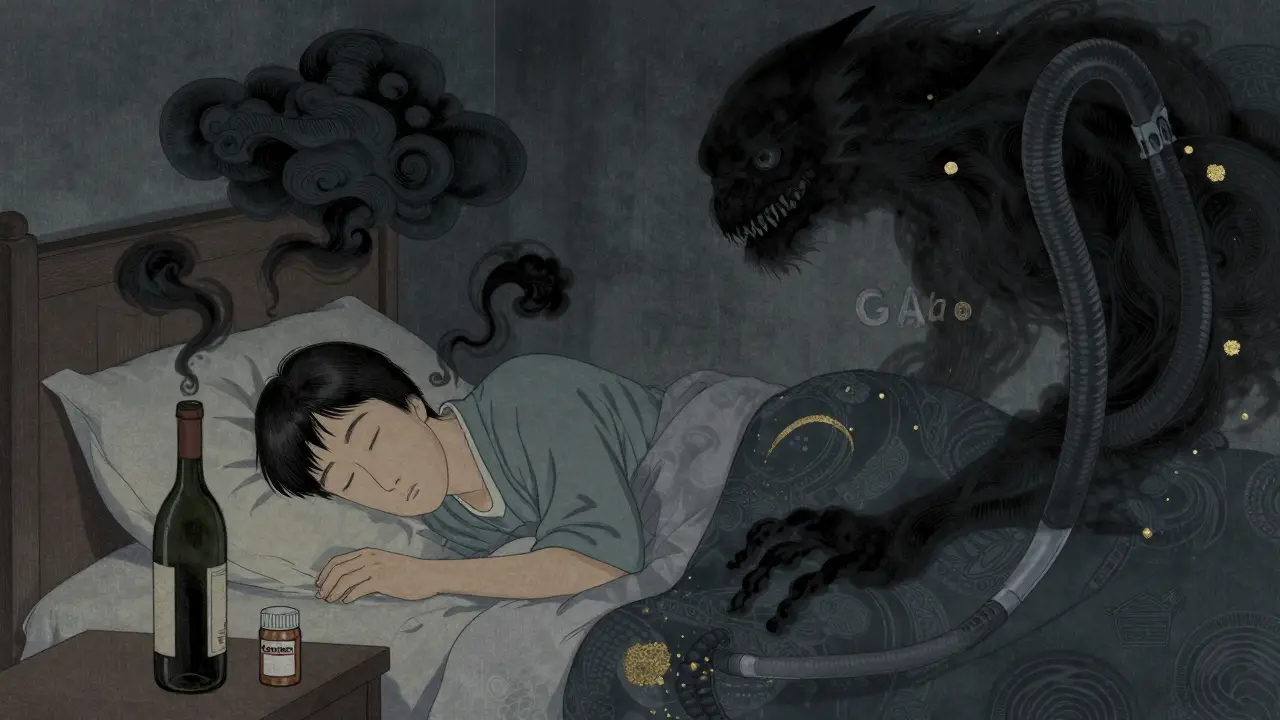
Drinking alcohol while taking sleep medication isn’t just a bad idea-it’s a medical emergency waiting to happen. You might think having a glass of wine to help you unwind before bed is harmless, especially if you’re already taking a pill to fall asleep. But the truth is, combining alcohol with prescription or over-the-counter sleep aids doesn’t just make you drowsy. It can shut down your breathing, cause you to sleepwalk miles from home without remembering it, or even kill you-even if you only had one drink.
Why This Combination Is So Dangerous
Both alcohol and sleep medications work by slowing down your central nervous system. They do this by boosting the effect of a brain chemical called GABA, which tells your body to relax. When you take them together, they don’t just add up-they multiply. That’s called synergy. One plus one doesn’t equal two. It equals five, or even ten. The most dangerous sleep meds are the Z-drugs: zolpidem (Ambien), eszopiclone (Lunesta), and zaleplon (Sonata). These were designed to be safer than older benzodiazepines like Ativan or Restoril. But when mixed with alcohol, they become far more risky. Clinical studies show that even a tiny amount of alcohol-like 0.02% blood alcohol concentration (that’s less than one standard drink)-can double the time Ambien stays in your body. Instead of wearing off in 2.5 hours, it lingers for over six. That means you’re sedated longer, deeper, and more dangerously than you ever intended. Your breathing slows down. Your oxygen levels drop. In one study, people taking Lunesta with a blood alcohol level of 0.08% (the legal driving limit in most U.S. states) saw their breathing rate fall from 16 breaths per minute to just 9.3. Their oxygen saturation dropped to 84.7%, dangerously close to the level where organs start to suffer damage. This isn’t theoretical. Emergency rooms across the U.S. are seeing a 27% spike in alcohol-sedative cases between 2018 and 2022.Who’s Most at Risk
Adults between 35 and 54 are the most common group visiting emergency rooms for these interactions. But the most deadly outcomes happen in older adults. People over 65 metabolize both alcohol and sleep meds much slower. Their liver can’t clear them as quickly, so the drugs build up. A single glass of wine with an OTC sleep aid like ZzzQuil (which contains diphenhydramine) can triple their risk of falling. And falls in older adults don’t just mean bruises-they mean broken hips, hospital stays, and sometimes death. The American Geriatrics Society updated its guidelines in 2022 to say that anyone over 65 taking any sleep medication should avoid alcohol entirely. Why? Because the combination increases the chance of delirium-sudden, severe confusion-by 400%. That’s not a typo. Four times more likely. And once someone enters delirium, recovery can take weeks, if it happens at all.OTC Sleep Aids Aren’t Safe Either
Many people think because something is sold over the counter, it’s harmless. That’s a deadly myth. Diphenhydramine (found in ZzzQuil, Benadryl, and many generic sleep aids) and doxylamine (in Unisom) are antihistamines. They’ve been around since the 1940s. They make you sleepy. But they also dry out your mouth, blur your vision, and slow your reflexes. Add alcohol, and those side effects go from annoying to life-threatening. A 2023 Cleveland Clinic report analyzed Medicare data and found that hip fractures from falls involving OTC sleep aids and alcohol jumped from 12.7 to 51.3 cases per 100,000 older adults in just a few years. That’s a 300% increase. And it’s not just falls. People report waking up disoriented, confused, or even in strange places-like outside their house, or in the garage-without any memory of how they got there. Reddit threads from people who’ve experienced this are chilling. One user, u/SleepWalker99, wrote: “Took half an Ambien with two glasses of wine. Woke up two miles from home. No memory of driving. Police found me parked on the side of the road.” This isn’t rare. Clinical trials show that combining alcohol with Z-drugs increases the chance of sleep-driving or sleep-walking by 16 times. From 0.15% to 2.4%.
What About Melatonin?
Melatonin is different. It’s not a sedative. It’s a hormone your body naturally makes to signal sleep. Studies show it doesn’t dangerously interact with alcohol like GABA-acting drugs do. But that doesn’t mean it’s risk-free. Mixing melatonin with alcohol still makes you more drowsy the next day-by about 35%. You might feel foggy, sluggish, or uncoordinated. If you’re driving, operating machinery, or need to be sharp, skip the wine.What the Experts Say
The FDA added a Black Box Warning-the strongest possible-to all Z-drugs in 2022. It says plainly: “Do not consume alcohol while taking this medication.” That warning wasn’t added lightly. Between 2015 and 2020, 372 people died from Ambien-alcohol interactions. The average blood alcohol level? 0.051%. That’s less than half the legal driving limit. These weren’t binge drinkers. They were people who had one drink and thought it was fine. Dr. Bankole Johnson from the University of Maryland found that 83% of these deaths happened at BAC levels below 0.08%. The assumption that “I’m not drunk, so I’m safe” is dangerously wrong. Your body doesn’t care about legal limits. It cares about how much alcohol is in your system-and how it interacts with the drug you took. The American Academy of Sleep Medicine calls this combination “medically negligent” to not warn patients about. And yet, a 2022 survey found that 68% of people prescribed sleep meds say they were never properly warned about alcohol risks during their doctor’s visit.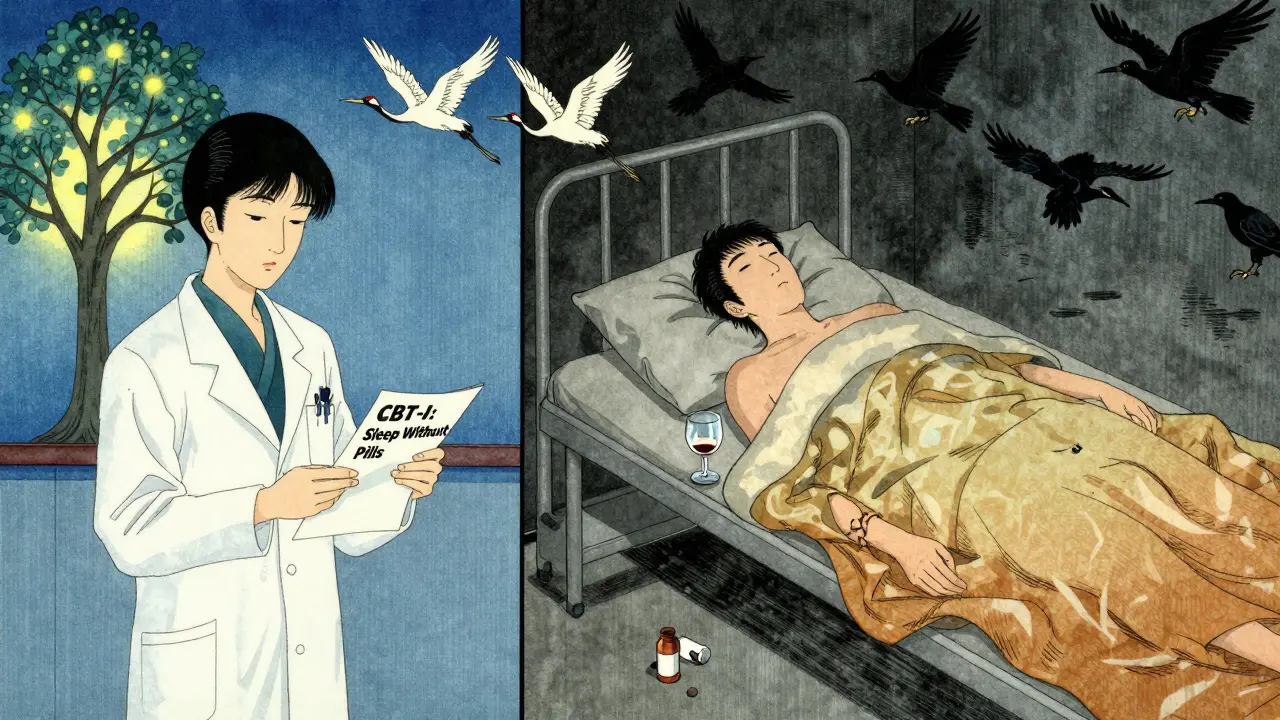
What Should You Do Instead?
If you’re using sleep meds because you can’t fall asleep, the first step is to talk to your doctor about alternatives. Cognitive Behavioral Therapy for Insomnia (CBT-I) is proven to be more effective long-term than any pill-and has zero risk of dangerous interactions. It’s not quick, but it lasts. Pills don’t fix the cause. CBT-I does. If you’re still taking a sleep medication, follow these rules:- Never mix alcohol with any prescription sleep aid. Not even one drink.
- Avoid OTC sleep aids entirely if you drink regularly. Even one glass of wine can be enough.
- Wait at least 6 hours after your last drink before taking a Z-drug. For benzodiazepines, wait 12 hours.
- For anyone over 65: no alcohol with any sleep medication. Period.
- Check your medication guide. The FDA now requires all sleep meds to have bold, clear warnings about alcohol. If you didn’t get one, ask your pharmacist.
Newer Options Are Safer-But Still Not Perfect
There’s hope. In 2023, the FDA approved Dayvigo (lemborexant), a new type of sleep drug that works differently. Instead of boosting GABA, it blocks orexin-a brain chemical that keeps you awake. Studies show it only increases its own half-life by 15% when mixed with alcohol, compared to 150-200% for Ambien. That’s a huge improvement. But it’s not zero risk. And it’s still a prescription drug. Don’t assume it’s safe to drink with. The bigger trend? Pharma companies are shifting away from GABA-targeting drugs entirely. Seven out of the 12 new sleep medications in clinical trials as of early 2024 use non-sedative mechanisms. That’s a sign the industry knows the old drugs are too dangerous.Final Warning
This isn’t about being perfect. It’s about being smart. If you’ve ever taken a sleep pill and had a drink afterward-even just one-you’ve already taken a risk. The good news? It’s not too late to change. Stop mixing. Talk to your doctor. Find safer ways to sleep. Your life depends on it.Can I have one glass of wine with Ambien if I wait a few hours?
No. Even if you wait six hours after drinking, alcohol can still be in your system and interact with Ambien. The risk isn’t just about being drunk-it’s about how the two substances amplify each other in your brain and lungs. The FDA and medical experts say no amount of alcohol is safe with prescription sleep aids. The interaction can happen at blood alcohol levels far below what you’d feel as "drunk."
Is it safe to take melatonin with alcohol?
Melatonin doesn’t cause dangerous sedation like Ambien or Lunesta, but mixing it with alcohol still increases next-day drowsiness by about 35%. You may feel foggy, slow to react, or uncoordinated. It’s not life-threatening, but it’s not harmless either. If you need to drive, work, or be alert the next day, avoid alcohol when using melatonin.
Why do I feel more tired the next day after mixing sleep meds and alcohol?
Alcohol disrupts the quality of your sleep-even if you fall asleep faster. It blocks REM sleep, the most restorative stage. Sleep medications also suppress deep sleep cycles. When you combine them, your brain doesn’t get the recovery it needs. You wake up exhausted, not refreshed. That’s why many people report 12+ hours of grogginess after mixing the two.
Can alcohol make sleep meds less effective?
It doesn’t make them less effective-it makes them too effective. Instead of helping you sleep safely, alcohol turns the medication into a powerful depressant. You might fall asleep faster, but you’re at higher risk of stopped breathing, sleepwalking, memory loss, or overdose. The goal isn’t to reduce effectiveness-it’s to prevent dangerous over-sedation.
What should I do if I accidentally mixed alcohol and sleep medication?
If you’ve taken them together and feel extremely drowsy, confused, have slow or shallow breathing, or can’t wake up properly, call emergency services immediately. Do not wait. If you’re with someone who took the combination and is unresponsive, turn them on their side to prevent choking and stay with them until help arrives. Even if you feel fine, monitor yourself closely for the next 6-8 hours. Symptoms can worsen slowly.

Darren Ramowski
My name is Calem Goodridge, and I am a pharmaceutical expert with a passion for educating others about medication and diseases. I have dedicated my career to researching and developing life-changing medical treatments. In my spare time, I enjoy writing articles and sharing my knowledge with the general public to help them make informed healthcare decisions. I am also an advocate for safe medication practices and believe that patient education is key to preventing adverse drug events. With my extensive experience in the pharmaceutical industry, I strive to make a positive impact on the lives of others through my writing.
This is why America's healthcare system is broken. People take pills like candy and then drink like it's a Friday night at the bar. No one teaches responsibility anymore. I've seen my uncle OD on Ambien and whiskey at 52. He's lucky to be alive. The FDA warning? Too little, too late. We need to stop treating medicine like a snack and start treating it like a weapon. Because that's what it becomes when you mix it with alcohol.
Thank you for writing this. I’ve been trying to tell my mom for months that she can’t have her nightly glass of wine with her ZzzQuil. She says it’s ‘just one drink’ and ‘she’s not drunk.’ But she’s 71 and woke up in the garage last month with no memory of how she got there. This article gives me the ammo I need to keep pushing. Please keep sharing facts like this.
One drink shouldn’t be a death sentence. But it is. And that’s the terrifying part.
Interesting how the data shows a 27% spike in ER visits between 2018 and 2022. That’s not just anecdotal-it’s a systemic failure. Why aren’t pharmacies required to print a red warning sticker on every bottle of sleep aid? Why isn’t this part of the prescription counseling? The lack of standardized patient education here is alarming. We’re leaving people to guess at risks that can kill them.
People always say one drink is fine. But one drink is never fine. You think you’re being smart by waiting six hours? That’s just wishful thinking. Alcohol stays in your liver longer than you think. Your body doesn’t care if you’re ‘not drunk.’ It only cares about the molecules. And when those molecules meet Ambien, your brain shuts down like a faulty circuit. I’ve seen it. My cousin did it. Woke up in a ditch. No memory. Police called it a miracle he didn’t die. You think you’re relaxed? You’re just one step from being a corpse with a wine stain on your shirt.
In India, we don’t mix alcohol with medicine. We have a word for it: ‘bhookha dawa’-hungry medicine. It means the drug is waiting to eat you if you give it alcohol. My grandfather used to say, ‘If you want to sleep, sleep. If you want to drink, drink. But never let them share the same room.’ Simple wisdom. No science needed.
The real danger isn’t the alcohol or the pills-it’s the cultural delusion that we can outsmart biology. We’ve turned our bodies into machines we can tweak with apps and pills, but we’re still just meat and neurons. GABA isn’t a suggestion. It’s a biological law. You don’t get to negotiate with your brainstem. When you combine two depressants, you’re not ‘enhancing sleep’-you’re playing Russian roulette with your medulla oblongata. And the fact that people still do this? That’s not ignorance. That’s arrogance.
so like... if i take melatonin and a glass of wine... i'm just gonna be super sleepy tmrw? 😅 not dead? ok cool i'll keep doing it then 🤷♂️🍷💤
I used to do this all the time-Ambien + wine-until I woke up standing in my kitchen at 3 a.m. holding a spatula, convinced I was making pancakes. I had no idea how I got there. I didn’t even like pancakes. That’s when I knew: my brain was on vacation without me. I switched to CBT-I. Took 3 months. I sleep better now. And I don’t have to wonder if I’m going to die before sunrise.
Have you ever considered that this whole ‘alcohol + sleep meds’ panic is orchestrated by Big Pharma to sell you CBT-I subscriptions and newer $800/month drugs like Dayvigo? The FDA’s black box warning? That’s not safety-it’s liability armor. The real reason they’re pushing non-GABA drugs is because they can patent them. Meanwhile, melatonin’s been around since the 70s and costs 99 cents. Why is it being sidelined? Who profits when you’re scared to have a glass of wine? Hint: not you.
I’m a 68-year-old who took Lunesta for three years with a glass of wine every night. I never had a problem-until I fell and broke my hip. My doctor said it was the combo. I didn’t believe him until I saw the data. Now I don’t drink. I don’t take pills. I read before bed. I drink chamomile tea. I sleep like a baby. It’s not magic. It’s just not poisoning myself. To anyone reading this: you’re not too old to change. And you’re not too smart to be wrong. I was both. And I got lucky. Don’t wait for luck.