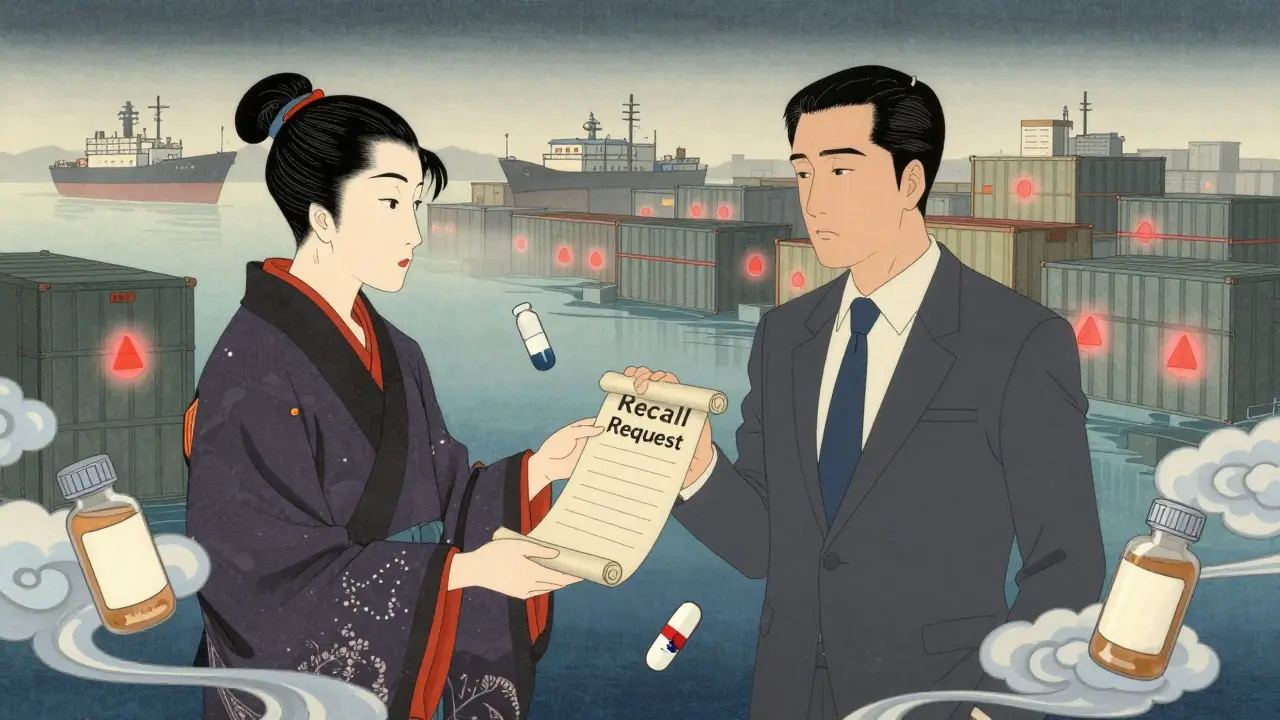
Many people assume the FDA can just pull a dangerous drug off the shelves the moment it’s found to be harmful. That’s not how it works. In reality, the FDA can’t force a company to recall a drug. Not directly. Not by law. Instead, the agency asks - repeatedly, urgently, sometimes with legal threats - for manufacturers to do it themselves. This gap in authority isn’t a glitch. It’s the law.
The FDA Doesn’t Have the Power to Order Drug Recalls
Under the Federal Food, Drug, and Cosmetic Act (FD&C Act), the FDA’s power over drugs is limited to requesting recalls. That’s it. The agency can’t issue a legal order to remove a medication from the market like it can with medical devices. This distinction is critical. For devices, the FDA has clear mandatory recall authority under 21 CFR 810. If a heart monitor or insulin pump poses a serious risk, the FDA can legally demand its removal. For a blood pressure pill, a painkiller, or a generic antibiotic? No such power exists.
Public confusion is common. News headlines often say, “FDA recalls drug X,” but that’s shorthand. What actually happened? The FDA flagged a problem - maybe through its MedWatch system, which received over 1.2 million adverse event reports in 2022 - and then contacted the manufacturer. The company, under intense pressure, agreed to recall. The FDA didn’t pull the drug. The company did. And they did it because the alternative - a federal court injunction, public shaming, or criminal liability - was far worse.
How Recalls Actually Happen
The process starts when a problem is identified. This could come from:
- Manufacturers discovering contamination during required annual stability testing
- Patients or doctors reporting side effects through MedWatch
- Foreign regulators alerting the FDA about unsafe batches imported from overseas
- Lab tests revealing unexpected impurities - like NDMA in valsartan, a carcinogen found in 2018
Once the FDA confirms the risk, it contacts the manufacturer and requests a recall. The agency doesn’t wait around. It sets expectations: Class I recalls - the most serious - now require action within 24 hours, down from 72 hours in 2010. The manufacturer must then develop a Recall Strategy, which includes:
- How far down the supply chain the recall goes (patient level? pharmacy level? distributor only?)
- How they’ll notify customers - via press releases, direct letters, or electronic alerts
- How they’ll collect and destroy returned products
If the company refuses? The FDA escalates. They can issue a public warning. They can inspect facilities. They can seize inventory. They can sue in federal court under Section 304 of the FD&C Act to get an injunction that stops all manufacturing and distribution. That’s the nuclear option. It’s slow, expensive, and rarely used - but it’s the only legal tool the FDA has when a company won’t cooperate.
The Three Classes of Drug Recalls
Not all recalls are created equal. The FDA classifies them based on risk:
- Class I: Highest risk. Use of the drug could cause serious injury or death. These make up just 2.1% of all drug recalls in 2022. Examples: pills contaminated with metal shards, insulin with incorrect potency, or medications containing undeclared allergens.
- Class II: Moderate risk. The product might cause temporary or reversible harm. This is the most common - 68.7% of all recalls in 2022. Think: mislabeled bottles, packaging errors, or drugs with slightly off potency levels.
- Class III: Lowest risk. The product won’t harm you, but it violates labeling or manufacturing rules. These are 29.2% of recalls. Examples: incorrect expiration dates, missing inserts, or minor labeling typos.
Class I recalls demand the most aggressive response. Hospitals and pharmacies are expected to trace affected lots down to individual patients. In 2022, 42% of hospital pharmacy directors reported delays in patient notification during Class I recalls - sometimes by more than three days - because lot numbers weren’t tracked consistently across manufacturers.
Why the System Is Broken - And Why It Still Works
Critics say the voluntary system is dangerously outdated. Dr. Sidney Wolfe of Public Citizen pointed to the 2018 valsartan recall as proof: it took six months for full market removal because Chinese API suppliers dragged their feet. The FDA had no legal power to force them to act.
But defenders argue the system works - because companies have every reason to comply. A refusal to recall means:
- Massive lawsuits from injured patients
- Permanent damage to brand reputation
- Loss of FDA approval for future products
- Public exposure in the media
In 2022, 99.7% of drug recalls were voluntary, and nearly all were completed within 10 days of FDA notification, according to FDA data. Only 3 out of 15,241 recalls between 2012 and 2022 required enforcement action. That’s a 99.98% success rate, according to PhRMA.
Still, the system is fragile. It assumes companies act ethically. It assumes supply chains are transparent. It assumes regulators have enough resources to monitor thousands of products. The pandemic exposed cracks. Global sourcing means contamination can come from halfway around the world - and the FDA can’t compel foreign manufacturers to act.
The Push for Change - And the Fight Against It
There’s been a long push to give the FDA mandatory recall power for drugs. The FD&C Modernization Act of 2022 included a provision - Section 604 - that would have done exactly that. But it was stripped out during committee markup. Why? Lobbying.
PhRMA, the pharmaceutical industry’s main lobbying group, spent $8.2 million in Q2 2023 alone to oppose mandatory recall authority. Their argument: the current system is effective. They point to the 99.98% voluntary compliance rate. They warn that mandatory recalls could lead to overreaction - companies recalling safe drugs out of fear.
But experts like Dr. Peter Lurie of the Center for Science in the Public Interest say that’s not the real risk. The real risk is delay. “We’re trusting companies to self-police when the stakes are life and death,” he wrote in a 2023 Health Affairs blog. “For biologics, complex injectables, and generics made overseas, that trust is too risky.”
The proposed PREVENT Pandemics Act (S.2871) includes Section 3103, which would finally grant the FDA explicit authority to order drug recalls. But as of late 2025, it’s still stuck in Congress. Industry opposition remains strong.

What Hospitals and Pharmacies Do to Protect Patients
Because the FDA can’t force action, healthcare providers have built their own safety nets. The American Society of Health-System Pharmacists (ASHP) recommends a 12-point recall protocol that includes:
- Assigning a recall coordinator in every pharmacy
- Using automated systems to scan incoming drug shipments for recall notices
- Creating a central database of recalled lots and their locations
- Training staff monthly on how to respond to Class I alerts
- Verifying patient records when a recall affects a medication they’re taking
Companies like Recall Masters and Recall Index now offer software services to 73% of U.S. hospitals, helping them track recalls in real time. These tools cost money - but they’re cheaper than a lawsuit or a patient death.
The Bigger Picture: Global Supply Chains and the Future
Today, 89% of Class I recalls involve products made outside the U.S. - mostly in India and China. The FDA inspects only a fraction of foreign facilities. When contamination is found, the agency can’t force a foreign company to act. It can only warn U.S. distributors - who may not even know they’re carrying the bad batch.
International efforts through the International Council for Harmonisation (ICH) are helping. More countries now share recall data in real time. But without legal teeth, it’s still a system built on cooperation - not control.
The truth is, the current system works - most of the time. But it works because manufacturers care about their reputation, not because the law forces them to. And that’s a dangerous assumption in a world where drug supply chains are more complex, global, and opaque than ever.
What You Can Do
If you take prescription medication:
- Check the FDA’s recall page monthly - it’s updated daily
- Keep your pill bottles. Lot numbers matter
- Sign up for FDA recall alerts via email
- Ask your pharmacist: “Is my medication on any recall list?”
Don’t assume your drug is safe just because it’s on the shelf. The system is designed to catch problems - but it’s not perfect. You’re your own last line of defense.

Darren Ramowski
My name is Calem Goodridge, and I am a pharmaceutical expert with a passion for educating others about medication and diseases. I have dedicated my career to researching and developing life-changing medical treatments. In my spare time, I enjoy writing articles and sharing my knowledge with the general public to help them make informed healthcare decisions. I am also an advocate for safe medication practices and believe that patient education is key to preventing adverse drug events. With my extensive experience in the pharmaceutical industry, I strive to make a positive impact on the lives of others through my writing.
This is wild. I always thought the FDA had full authority to yank dangerous drugs. Turns out they’re just asking nicely while people might be dying. No wonder so many recalls take too long.
My grandma took a recalled blood pressure med for weeks before her pharmacist caught it. She got lucky.
I work in a hospital pharmacy and we’ve got software that auto-scans for recalls, but it’s still a mess. Lot numbers aren’t standardized across manufacturers, and sometimes the alerts come in late. We’ve had Class I recalls where we didn’t notify patients for 72 hours because the batch wasn’t logged right.
It’s not the FDA’s fault - it’s the whole system. We’re patching holes with duct tape and hope.
The notion that American regulatory oversight should be subject to the whims of foreign manufacturers is an affront to national sovereignty. The FDA’s inability to compel recall of life-threatening pharmaceuticals manufactured in India and China represents a catastrophic failure of governance. We have permitted our medical supply chain to be outsourced to jurisdictions with no accountability, no transparency, and no respect for American lives.
It is not merely incompetence - it is surrender. The FD&C Act must be rewritten to grant the FDA the power to seize, destroy, and criminally prosecute those who endanger the American public. Anything less is treasonous negligence.
As someone from Nigeria, I find this deeply familiar. Our own drug regulators face the same problem - they can only request recalls, and manufacturers often ignore them. The global supply chain makes this worse. A batch of fake metformin from China ends up in Lagos, and no one has the power to stop it.
Maybe the solution isn’t just more power for the FDA - it’s global cooperation with teeth. We need a WHO-backed recall enforcement body, not just warnings.
99.98% compliance rate? That’s the industry’s PR spin. That number doesn’t include the recalls that never got reported, or the ones where companies quietly pulled products without telling anyone. I’ve seen pills with no labels in Indian pharmacies - no recall, no warning, just gone.
And the FDA doesn’t inspect 90% of foreign factories. How is that even legal?
Check your lot numbers
Sign up for alerts
Ask your pharmacist
But what if you’re on Medicaid and your pharmacy doesn’t even have time to look?
Or you’re elderly and don’t have email?
Or you just trust your doctor?
It’s not enough to say "you’re your own last line of defense" when the system was never meant to put that burden on you
we trust companies to self police because we believe in human nature right? but what if the system is designed to make ethics optional? capitalism rewards speed over safety, and the law reflects that. the FDA is a moral compass in a world that sold its soul for efficiency.
maybe the real question isn't who has the power to recall... but why we let profit decide who lives and who dies
In India, we have a similar regulatory framework - but with far fewer resources. The fact that the U.S. has a 99.7% voluntary compliance rate is actually impressive, given the scale. The system works because of corporate self-interest, not because of legal compulsion - and that’s a sign of a mature market.
Instead of demanding more power for the FDA, we should invest in better supply chain traceability, blockchain-based lot tracking, and real-time global alerts. Technology can bridge the gap where law cannot.
The structural deficiency lies in the absence of statutory mandation under 21 U.S.C. § 381, which permits seizure of adulterated devices but not pharmaceuticals. This is a statutory anomaly rooted in historical legislative compromises from the 1938 FD&C Act - a relic of pre-globalized pharma.
Current enforcement mechanisms - injunctions under § 304 - are administratively inefficient, with an average lead time of 14–21 days for judicial review. The cost-benefit analysis favors noncompliance for firms with low marginal liability exposure.
Without codified recall authority, the FDA remains a regulatory bystander in pharmacovigilance - a position incompatible with contemporary risk profiles.
so the FDA can’t force a recall… but they can sue? wow. that’s like saying "you can’t force your kid to clean their room, but you can take them to court."
also why is the FDA still using "MedWatch" like it’s 2005? no one uses that. i got a recall alert because my pharmacist texted me. not the fda.
also i’m pretty sure my blood pressure med was recalled last year and i didn’t find out until i saw it on reddit. 🤡