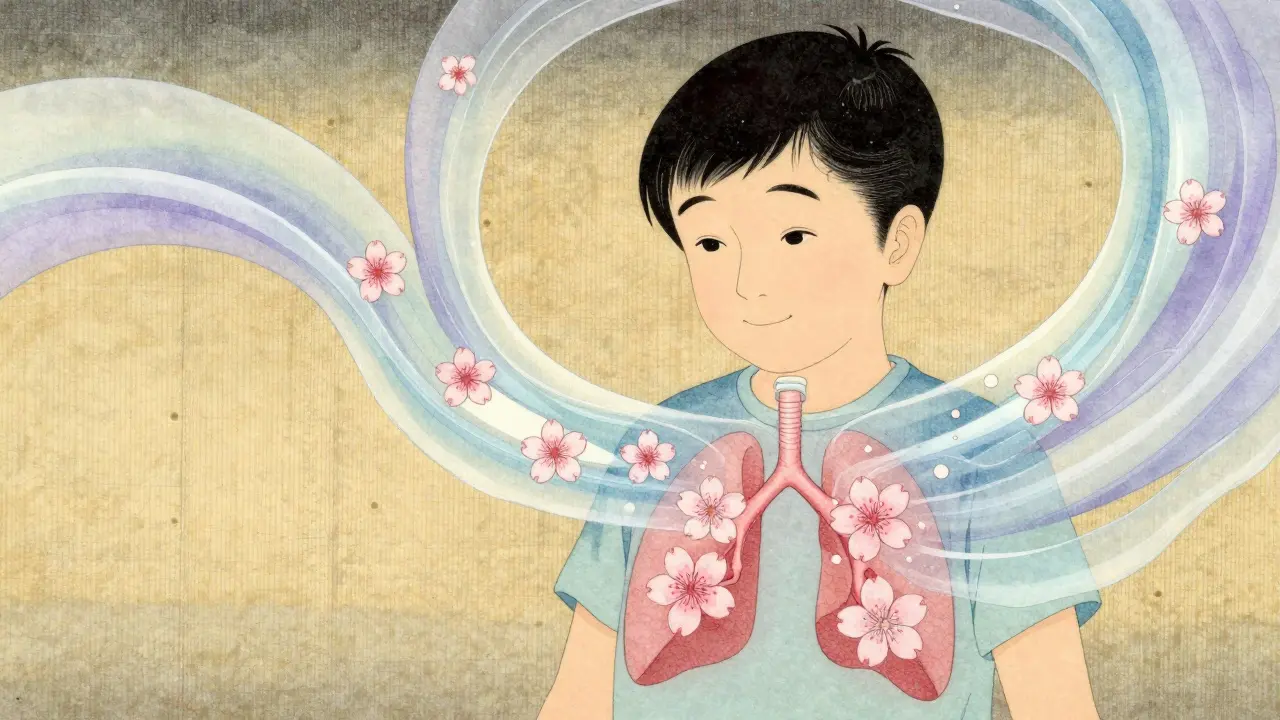
Cystic fibrosis isn't just another lung disease. It’s a genetic condition that rewires how your body handles salt and water-turning mucus from a slippery protector into a thick, sticky trap. This isn’t something that shows up overnight. It’s been hiding in human DNA for centuries, quietly damaging lungs, pancreas, and liver from birth. Today, thanks to breakthrough science, people with cystic fibrosis aren’t just surviving longer-they’re living fuller lives than ever before.
What Cystic Fibrosis Really Does to Your Body
Cystic fibrosis starts with a single broken gene: CFTR. This gene tells your cells how to move chloride ions in and out. When it’s faulty, salt and water get stuck where they shouldn’t be. The result? Mucus that’s thick enough to clog airways, block pancreatic ducts, and trap bacteria like Pseudomonas aeruginosa in your lungs. That’s not just a cough-it’s chronic infection, inflammation, and slowly failing lungs.
Eighty-five percent of people with CF also have pancreatic insufficiency. Their body can’t release digestive enzymes, so food passes through undigested. Without enzyme pills taken with every meal, they can’t gain weight or absorb vitamins. And for men, nearly all are infertile because the tube that carries sperm never forms properly.
The diagnosis? Sweat test. It’s simple: measure chloride in sweat. Levels above 60 mmol/L? That’s CF. Newborn screening now catches it in all 50 U.S. states, meaning kids start treatment before symptoms even show up.
The Old Way: A Daily Battle
Before 2012, managing CF meant treating symptoms, not the cause. A typical day for an adult without new therapies? Two to three hours of treatments. Chest physiotherapy to shake loose mucus. Nebulizers with antibiotics and bronchodilators. Six to twelve enzyme capsules with every meal. Vitamin supplements. Oxygen sometimes. It was exhausting. And it didn’t stop the damage.
By age 14 in the 1960s, the median survival was just 14 years. By 2022, it jumped to 50.9. That’s not magic. It’s decades of grinding work-airway clearance, nutrition, antibiotics, lung transplants. But even then, the disease kept winning. People were living longer, but not living well. The burden was crushing.
The Turning Point: CFTR Modulators
In 2012, everything changed. Ivacaftor (Kalydeco) became the first drug to fix the broken CFTR protein itself-not just clean up the mess. It worked for people with the G551D mutation, improving lung function by over 10%. For the first time, patients weren’t just managing decline-they were getting stronger.
Then came Trikafta. A triple combo of elexacaftor, tezacaftor, and ivacaftor. Approved in 2019 for people with at least one F508del mutation (the most common, found in 70% of cases), it changed lives overnight. One 28-year-old told the CF Foundation community: within three months, his daily airway clearance dropped from 90 minutes to 20. He could sleep through the night. He gained weight. He started working again.
Trikafta boosted lung function by 13.8% in trials and cut pulmonary flare-ups by 63%. In the CF Foundation’s 2022 survey of nearly 8,000 people, 89% said they breathed easier, 76% had fewer hospital visits, and 68% gained weight. These aren’t small wins. These are life-changing.

Who Doesn’t Benefit-and Why
But here’s the hard truth: not everyone gets this miracle. About 10% of people with CF have mutations that don’t respond to current modulators. These are often rare, Class I mutations-nonsense mutations where the protein doesn’t even start forming. For them, Trikafta does nothing. They’re still stuck with the old routine: hours of therapy, constant antibiotics, declining lung function.
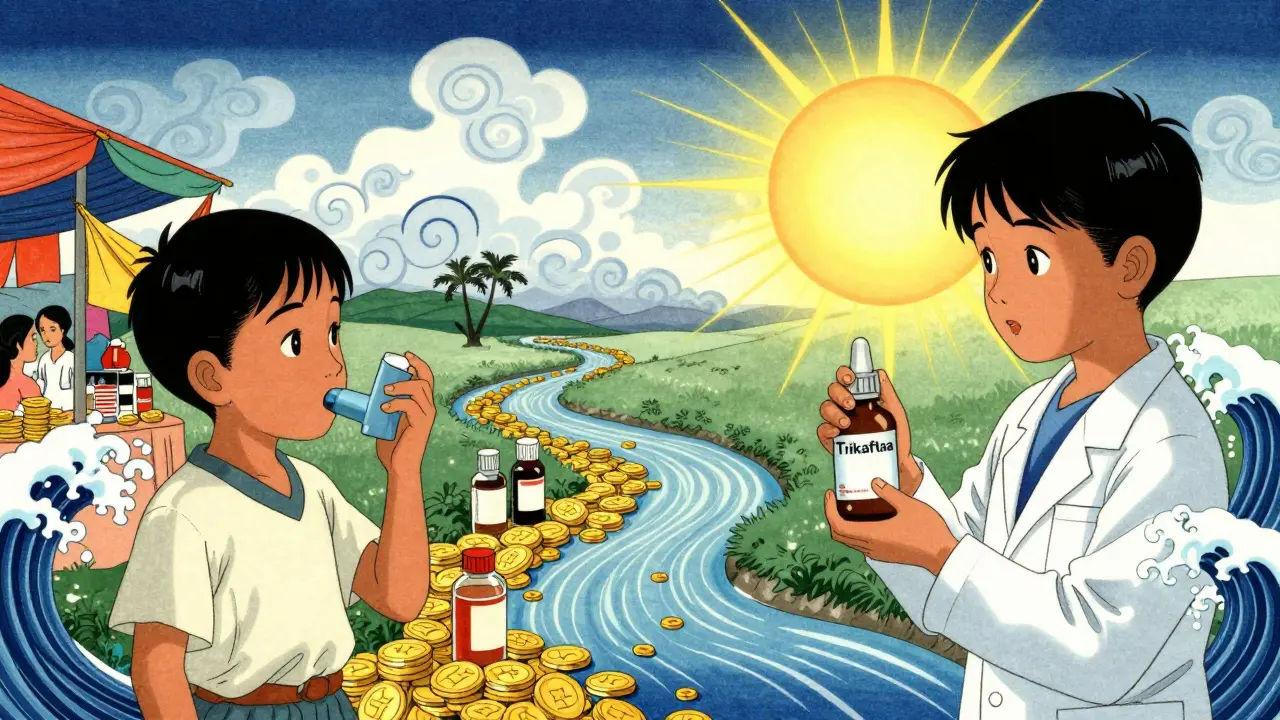
And it’s not just about the mutation. Cost is a wall. In the U.S., Trikafta costs about $300,000 a year. Even with insurance, out-of-pocket costs average $1,200 a month. Forty-two percent of patients report financial strain. Globally, only 35% of people with CF have access to modulators. In low-income countries, that number drops below 10%. The WHO calls it a crisis of inequity. A child born with CF in Nairobi has a life expectancy of under 10 years. A child born in New Zealand or Canada? Close to 50.
The Side Effects You Don’t Hear About
These drugs aren’t perfect. Some people get liver enzyme spikes. In phase 4 studies, 3.2% had to stop treatment because of liver damage. Others report headaches, nausea, or cataracts in children. One Reddit user wrote in May 2023: “I started Trikafta and felt amazing-until my ALT levels shot up. They told me to stop. I cried for a week.”
There’s also the psychological toll. People who’ve spent decades on treatment feel guilty for feeling better. “Why do I feel so guilty for being healthy?” one patient asked on a CF forum. Others worry about long-term unknowns. These drugs are new. We don’t know what 40 years of modulators will do to the liver, kidneys, or hormones.
The Future: What’s Coming Next
Research hasn’t stopped. The Cystic Fibrosis Foundation is pouring $100 million into a “Path to a Cure” initiative targeting the 10% left behind. Clinical trials are testing mRNA therapies to fix nonsense mutations. CRISPR gene editing is being tried to correct CFTR at the DNA level. New inhaled antibiotics are being designed to break through the biofilm that protects Pseudomonas in the lungs.
Trikafta is now approved for kids as young as two. That means children are starting treatment before lung damage even begins. The median age of people with CF is now 28-more than half are adults. That’s a revolution. In 1990, most CF patients didn’t live to see high school.
Vertex Pharmaceuticals controls 95% of the modulator market. Their drugs brought in $6.2 billion globally in 2022. But the Cystic Fibrosis Foundation didn’t wait for Big Pharma. They invested $150 million in early research back in 2000. That venture philanthropy model-funding science before it was profitable-is what made these drugs possible.
What This Means for You or Someone You Love
If you or a loved one has CF, here’s what matters now:
- Get genetic testing to know your exact mutations. Not all CF is the same.
- Ask your care team: “Am I eligible for a modulator?” If you’re not, ask why-and what’s being done for your mutation.
- Connect with the Cystic Fibrosis Foundation. They offer 24/7 support, care center referrals, and financial aid programs.
- Don’t skip airway clearance or enzymes-even if you feel great. Modulators help, but they don’t replace foundational care.
For families: This isn’t just a medical condition. It’s a life that’s been rebuilt. A child who used to miss school every month is now playing soccer. A parent who couldn’t hold a job is now working part-time. A teenager who used to fear her 20s is now planning college. That’s the power of science, persistence, and community.
Still Questions? Here’s What People Ask
Can cystic fibrosis be cured?
Not yet. But CFTR modulators have turned CF from a fatal childhood disease into a manageable chronic condition for most. For the 10% who don’t respond to current drugs, researchers are working on gene editing and mRNA therapies. A true cure-one that permanently fixes the gene-is still in development, but the path is clearer than ever.
How do I know if I’m a carrier of cystic fibrosis?
Carriers have one faulty CFTR gene but no symptoms. If you have a family history of CF, or if you’re planning a pregnancy, genetic testing can tell you your carrier status. About 1 in 25 people of Northern European descent are carriers. Testing is simple-a blood or saliva sample-and widely available.
Is cystic fibrosis the same as asthma or COPD?
No. Asthma and COPD are triggered by inflammation or smoking, and they don’t involve genetic mutations in CFTR. CF is a genetic disease from birth, with thick mucus as the core problem. People with asthma can use inhalers and feel fine. People with CF need daily, lifelong treatment for multiple organs-even if their lungs feel okay today.
Why are CFTR modulators so expensive?
They’re rare disease drugs-made for a small group of patients, with high R&D costs. Vertex developed them after decades of research funded partly by the Cystic Fibrosis Foundation’s $750 million investment. The price reflects the cost of development, not production. But access remains unequal. Many countries can’t afford them. Advocacy groups are pushing for price caps and global access programs.
Can someone with CF have children?
Women with CF can often have children, though pregnancy carries higher risks due to lung function and nutrition demands. Men with CF are almost always infertile due to missing vas deferens, but they can become biological fathers using IVF with sperm retrieved directly from the testes. Genetic counseling is essential-both partners should be tested for CF mutations before conception.

Darren Ramowski
My name is Calem Goodridge, and I am a pharmaceutical expert with a passion for educating others about medication and diseases. I have dedicated my career to researching and developing life-changing medical treatments. In my spare time, I enjoy writing articles and sharing my knowledge with the general public to help them make informed healthcare decisions. I am also an advocate for safe medication practices and believe that patient education is key to preventing adverse drug events. With my extensive experience in the pharmaceutical industry, I strive to make a positive impact on the lives of others through my writing.
My cousin has CF and started Trikafta last year. She went from needing oxygen at night to hiking weekend trails. I still cry when I think about it.
It’s not just medicine-it’s her getting to be a normal teenager.
Reading this made me realize how lucky I am. I’ve known people with CF since college and the difference before and after modulators is like night and day.
Still… the cost is insane. How is this even legal?
In India, we don’t even have access to basic nebulizers in rural clinics.
Trikafta? More like a fantasy. We’re still fighting for clean air, let alone $300k drugs.
Oh wow so now we’re supposed to be grateful that a billionaire pharma company decided to fix a disease they ignored for decades?
Don’t act like they’re saints. They waited until the market was big enough to monetize.
As someone from Nigeria, I can say this: the disparity is not just economic-it’s moral.
Children die here because a pill exists but is locked behind a wall of profit.
We need global solidarity, not charity campaigns.
CF shouldn’t be a luxury. It’s a human right.
Why does a child’s lifespan depend on their zip code?
This isn’t science-it’s systemic violence dressed in white coats.
And yet, I still believe in progress.
But progress without justice is just a fancy word for more suffering.
i think maybe the real cure is not in genes but in how we value life
why do we spend billions on one drug and not on clean water or air
maybe the mutation is not in cftr but in our hearts
we fix molecules but ignore humanity
is that not the real disease
The real miracle isn’t Trikafta-it’s the CF Foundation’s venture philanthropy model.
They bet on science before it was profitable.
That’s the playbook we need for every rare disease.
Big Pharma didn’t save CF.
Community did.
They funded the lab work, pushed regulators, built the infrastructure.
Vertex just rode the wave.
And now they’re charging $300k/year like it’s a subscription to Netflix.
They didn’t build the house.
They just put a fancy door on it and raised the rent.
So let me get this straight-kids in Nairobi die before 10 because a drug costs more than their country’s annual health budget?
And we’re supposed to be impressed by a 13.8% lung improvement?
Bro. That’s not progress.
That’s a moral emergency wrapped in a press release.
Also, who’s paying for the liver damage from Trikafta?
Because I’m guessing it’s not Vertex’s shareholders.
It’s fascinating how we treat CF as a medical problem when it’s really a political one.
The science has been there for 20 years.
The funding came from patient families, not investors.
And yet, access is dictated by GDP, not genetics.
We’ve engineered a cure.
But we haven’t engineered justice.
Maybe the next breakthrough isn’t in a lab.
Maybe it’s in the courtroom.
How quaint. A pharmaceutical breakthrough that benefits only the privileged.
How utterly predictable.
And here I thought we’d moved beyond the Victorian era of medical elitism.
Apparently not.
One wonders if the researchers who developed Trikafta ever sat with a child in Lagos, watching her struggle to breathe while her mother prayed for a single dose.
Or perhaps they were too busy calculating their quarterly EPS.
How tragic.
How utterly, devastatingly bourgeois.
bro i had a friend with CF and he died last year
he was 22
he took like 8 pills a day and still cried every night
they told him Trikafta was too expensive
so he just stopped
now he’s gone
and i just sit here wondering why i’m still breathing
why do some of us get to live and others just… disappear
As an Indian officer, I have seen how healthcare inequality kills silently.
Trikafta is not just a drug-it’s a symbol of global injustice.
Every life matters, whether in Delhi or Detroit.
Our government must negotiate with Vertex for generic access.
And citizens must demand it.
This is not a medical issue.
This is a civilizational test.
Will we choose compassion-or convenience?
wait trikafta causes cataracts in kids??
i read somewhere it also makes you grow hair on your palms
and i think it turns your pee blue
is that true??
also i heard vertex is owned by the illuminati
so like… is this all a plot??
The data is clear: CFTR modulators have transformed life expectancy and quality of life for the majority.
However, the 10% without actionable mutations remain critically underserved.
Current research into mRNA and CRISPR is promising but requires sustained funding.
Equitable access remains the most urgent ethical challenge in modern medicine.
Policy interventions must prioritize global affordability over patent protection.
Collaborative models between governments, NGOs, and biotech firms are not optional-they are imperative.
Science has delivered.
Now society must follow.
you know who really controls this? the deep state
CF was never just a disease
it was a test
they let people suffer so they could sell you a miracle later
triakfta is a trap
they want you dependent
they want you paying monthly
they want you too scared to question
and the truth? they already have a cure
but they won’t release it
because then they’d lose the money
and you’re all just sheep
wake up