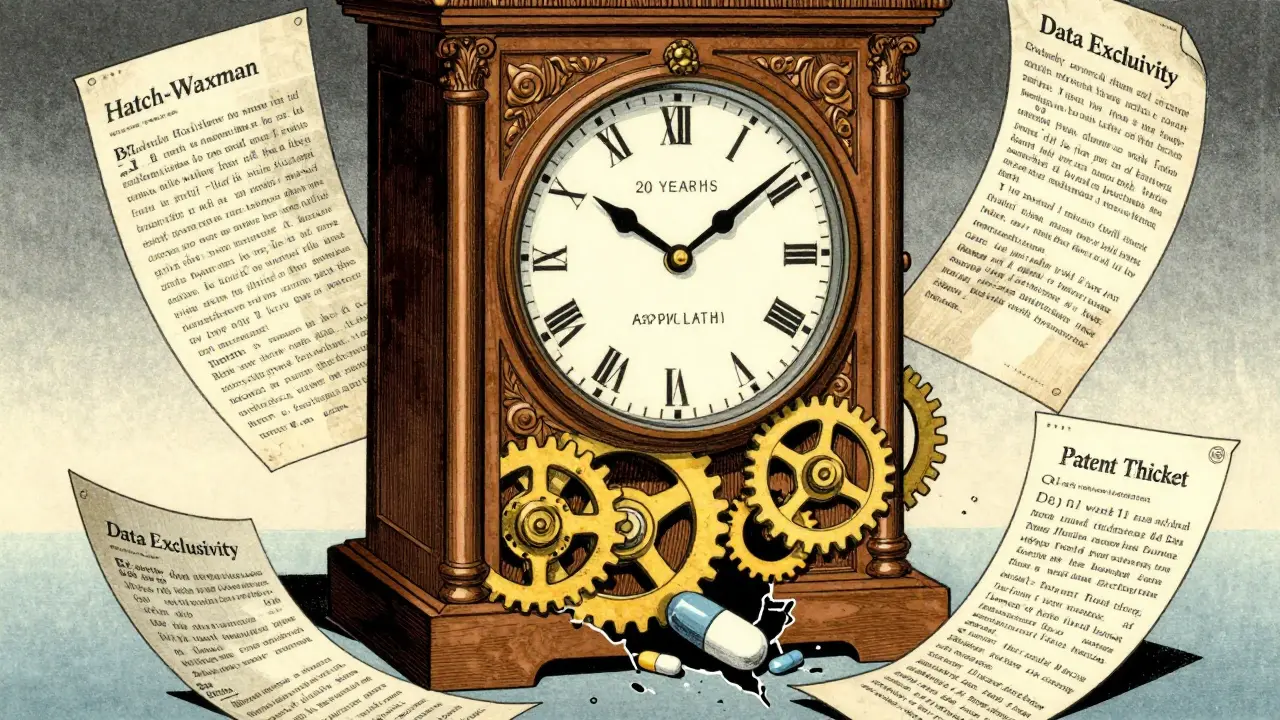
When a brand-name drug hits the market, it doesn’t stay alone for long. Somewhere down the line, a cheaper version will show up - but not before a long, legal game of wait-and-see. That waiting period isn’t just about patents. It’s a mix of patents, data protection, legal loopholes, and country-specific rules that decide when generics can finally enter. And those rules? They’re wildly different from one country to the next.
How long does a drug stay protected?
The basic patent clock starts ticking when the drug is first filed - not when it’s approved. That’s crucial. It takes, on average, 10 to 12 years just to get a new drug from lab to pharmacy shelf. So by the time the FDA or EMA says "yes," you’ve already used up most of your 20-year patent. That leaves only 6 to 10 years of real market control. That’s not enough to recover the $2.3 billion it typically costs to bring a drug to market.
That’s why countries built extra layers on top of patents. In the U.S., the Hatch-Waxman Act of 1984 created a system where innovators can get patent term extensions - up to 5 extra years - but only if they haven’t already used up too much time. And even then, the total protected time after approval can’t go beyond 14 years. So if your drug got approved in 2015 and you got the full 5-year extension, your patent expires in 2029, even if it was filed in 2005.
The EU does something similar with Supplementary Protection Certificates (SPCs). They also give up to 5 extra years, but the total combined time - patent plus SPC - can’t exceed 15 years from the date the drug was first authorized. So if a drug got approved in 2018 and got a 5-year SPC, it’s protected until 2033. But if it was approved in 2010, the max protection ends in 2025, no matter how long the patent lasted.
It’s not just patents - data exclusivity is the real gatekeeper
Here’s where most people get confused. Even if a patent expires, a generic company can’t just copy the original drug’s clinical data to get approved. That’s where data exclusivity comes in. This rule says: "You can’t use our safety and effectiveness studies to get your version approved." It’s not about patents - it’s about who owns the research.
In the U.S., a new chemical entity gets 5 years of data exclusivity. That means no generic can even file for approval using the brand’s data until that clock runs out. But here’s the twist: the patent might still be active during those 5 years. So the generic can’t enter until both the patent and data exclusivity are gone.
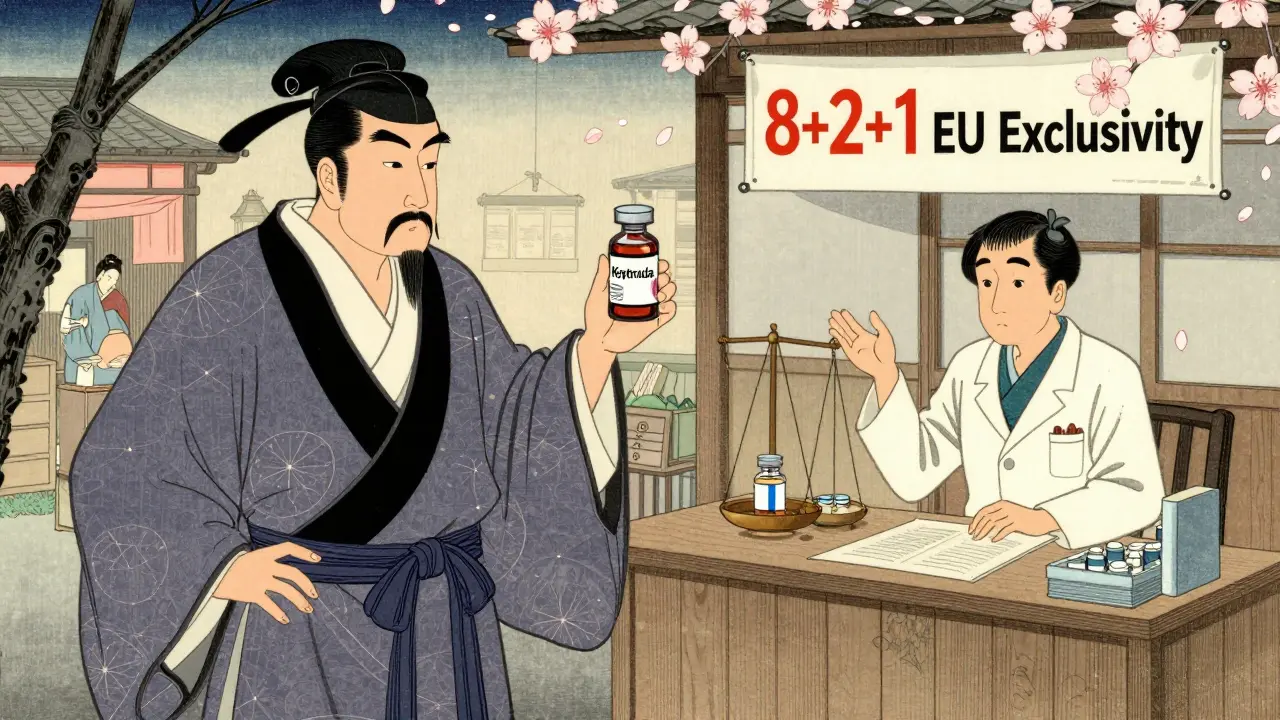
The EU has a more complex system: 8+2+1. That means:
- 8 years of data exclusivity - no generic can use the originator’s data to apply.
- 2 years of market exclusivity - even if the generic gets approved, it can’t sell until those 2 years are up.
- 1 extra year if the brand adds a new, significant medical benefit during the first 8 years.
Canada follows the EU model closely. Japan gives 8 years of data protection and 4 years of market exclusivity. Brazil and China have moved toward longer terms too - Brazil now gives 10 years, China 12. That’s a big shift. It means generics in those countries face longer delays, even after patents expire.
The U.S. has a wildcard: the 180-day exclusivity for first challengers
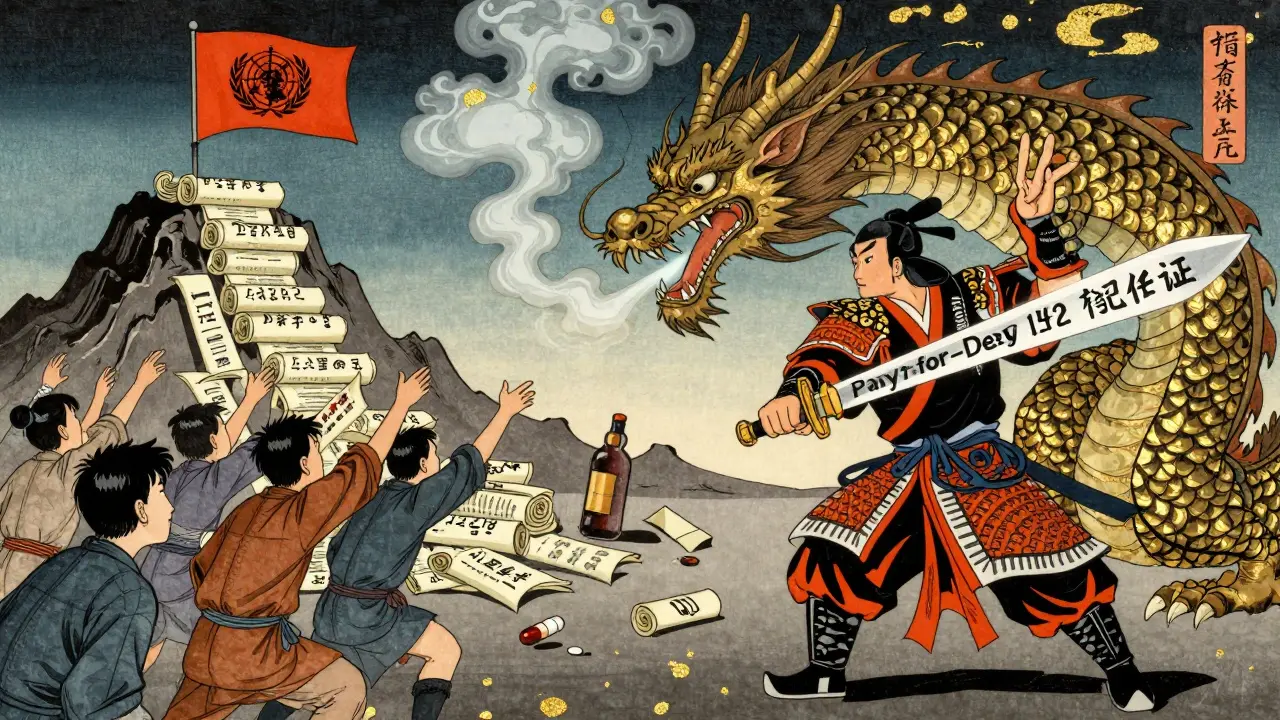
The U.S. is the only country with a system that rewards generic companies for fighting patents. Under the Hatch-Waxman Act, if a generic manufacturer files a Paragraph IV certification - meaning they claim a patent is invalid or won’t be infringed - and they win, they get 180 days of exclusive market access. No other generic can enter during that time.
That sounds fair. But in practice, it’s been exploited. Some brand companies pay the first generic challenger to delay launch - a deal called "pay-for-delay." The FTC has gone after these deals, but they still happen. In 2023, 78% of U.S. pharmacists reported seeing delays in generic availability because of these settlements.
And it’s not just one patent. The average brand drug now has 142 patents listed in the FDA’s Orange Book. That’s not a mistake - it’s strategy. Companies file patents on everything: the pill shape, the coating, the dosage timing, even the manufacturing process. It’s called a "patent thicket." And it’s designed to slow down generics by forcing them to challenge dozens of patents - each one costing millions in legal fees.
Why does this matter for patients and prices?
When a generic enters, prices drop fast - typically 80% to 90% within a year. That’s why the global pharmaceutical market is watching 2023 to 2028 closely: $356 billion in brand drug sales are set to lose patent protection in that window. That’s billions in savings waiting to happen.
But in low-income countries, those savings don’t come fast. The WHO found that essential medicines reach generic status in high-income countries after 12.7 years on average - but take 19.3 years in low-income ones. Why? Because trade deals like CETA or the USMCA force developing countries to adopt data exclusivity rules that don’t exist in their own laws. So even when a patent expires, generics can’t enter because they can’t use the clinical data.
Take HIV meds. In South Africa, data exclusivity in EU trade agreements delayed generic access by up to 11 years after patent expiry. That’s not a technicality - it’s a death sentence for people who can’t afford the brand.
Who’s winning? Who’s losing?
Brand companies argue they need this protection. Merck says Keytruda’s effective market life was extended from 8.2 to 12.7 years through patents and exclusivity - money they used to fund the next wave of cancer drugs. PhRMA says without this, the 14% failure rate in Phase III trials would kill innovation.
But critics point out the math doesn’t add up. Harvard’s Dr. Aaron Kesselheim found that originator companies get an average of 38 additional patents per drug - many on tiny changes like a new salt form. That’s not innovation. That’s legal maneuvering.
Generic manufacturers like Teva say they’re stuck in a legal maze. One patent challenge can cost $2 to $5 million. And 42% of generic applications fail because companies misjudge the patent landscape.
Patients and pharmacists see the real cost: delayed access. The Multiple Myeloma Research Foundation credits the U.S. orphan drug exclusivity for 12 new treatments since 2003. But Health Action International documented how those same rules blocked affordable HIV drugs in Africa for over a decade.
What’s changing in 2026?
Pressure is building. The U.S. Congress is pushing the Preserve Access to Affordable Generics Act to ban pay-for-delay deals. The EU is proposing to cut data exclusivity from 8 to 5 years for some drugs. Japan is speeding up its patent review system. And the WHO is calling for a global rebalancing - especially for essential medicines.
But the system isn’t collapsing. The IFPMA says 97% of big pharma companies still see current rules as essential. And with $58 billion in brand sales set to expire in 2024 alone, companies aren’t going to give up without a fight.
What’s clear? The game has changed. It’s no longer just about patents. It’s about data, legal strategy, trade deals, and who gets to decide when a life-saving drug becomes affordable.
What’s next for generic access?
If you’re waiting for a generic drug to become cheaper, here’s what you need to know:
- Check if the patent has expired - but don’t stop there.
- Find out if data exclusivity still applies - that’s often the real barrier.
- Look up the country’s rules. The U.S. and EU aren’t the same.
- Watch for "pay-for-delay" deals - they’re why some generics don’t show up even after patents expire.
- Advocacy matters. Pressure on lawmakers and trade negotiators can shorten exclusivity for essential drugs.
The system isn’t broken - it’s rigged. And the people paying the price aren’t the CEOs or lawyers. They’re the ones who need the medicine.
How long do generic drug patents last in the U.S.?
The standard patent lasts 20 years from the filing date, but most drugs only have 6-10 years of actual market protection because development takes so long. The U.S. allows patent term extensions of up to 5 years, but the total protection after approval can’t exceed 14 years. So a drug approved in 2015 with a full extension would lose protection in 2029, even if the patent was filed in 2005.
What’s the difference between patent expiration and data exclusivity?
A patent protects the chemical formula and prevents others from making the drug. Data exclusivity blocks generic companies from using the brand’s clinical trial data to get approval - even if the patent is gone. In the U.S., data exclusivity lasts 5 years for new chemical entities. In the EU, it’s 8 years of data protection plus 2 years of market exclusivity. So a generic might be legally allowed to apply before the patent expires, but it still can’t get approved until data exclusivity ends.
Why do some countries have longer exclusivity than others?
It’s mostly about trade agreements and political pressure. The U.S. and EU have pushed for longer data exclusivity in free trade deals with countries like Brazil, China, and South Africa. These rules often go beyond what’s required by international law (TRIPS), forcing developing nations to delay generic access even after patents expire. The goal is to protect pharmaceutical profits - but the cost is slower access to affordable medicines.
What is the 180-day exclusivity period in the U.S.?
It’s a reward given to the first generic company that successfully challenges a brand drug’s patent under the Hatch-Waxman Act. That company gets 180 days of exclusive sales - no other generic can enter during that time. But it’s been abused. Sometimes, brand companies pay the first generic to delay entry - a "pay-for-delay" deal. These deals are illegal under antitrust law, but they still happen, and they’re a major reason why generics don’t always appear right after patent expiry.
Do orphan drugs get longer exclusivity?
Yes. In the U.S., orphan drugs get 7 years of exclusivity, regardless of patent status. In the EU, it’s 10 years, with a possible 2-year extension if the drug treats a very rare condition. This is meant to encourage development for diseases that affect fewer than 200,000 people. While it’s helped bring new treatments for rare cancers and genetic disorders, it’s also been used to extend exclusivity for drugs that could be used more widely.
Can a generic drug enter before the patent expires?
In the U.S., yes - if the generic company files a Paragraph IV certification challenging the patent’s validity or claiming it won’t be infringed. If they win in court, they can enter before patent expiry and get the 180-day exclusivity. In the EU, generics can’t enter before patent expiry unless the patent is invalidated by a court - and there’s no incentive system like the 180-day reward. So generic entry in Europe is usually slower and more predictable.
Are there efforts to shorten exclusivity periods globally?
Yes. The EU is proposing to reduce data exclusivity from 8 to 5 years for some drugs. The U.S. is trying to ban pay-for-delay deals. The WHO is urging countries to align exclusivity with actual R&D costs, especially for essential medicines. But big pharma is fighting back. With $356 billion in brand sales set to expire by 2028, companies have a lot to lose - and they’re using lobbying, trade deals, and legal strategies to keep protections in place.

Darren Ramowski
My name is Calem Goodridge, and I am a pharmaceutical expert with a passion for educating others about medication and diseases. I have dedicated my career to researching and developing life-changing medical treatments. In my spare time, I enjoy writing articles and sharing my knowledge with the general public to help them make informed healthcare decisions. I am also an advocate for safe medication practices and believe that patient education is key to preventing adverse drug events. With my extensive experience in the pharmaceutical industry, I strive to make a positive impact on the lives of others through my writing.
This is why I can't trust the system. I had to pay $800 for a pill last year that's been around for decades. The math doesn't add up. The people who need it most are the ones getting screwed.
And no, I don't care about pharma profits. My mom's life is worth more than their quarterly earnings.
It's fascinating how we've turned medicine into a legal chess match rather than a public health imperative. The 20-year patent was designed for an era when innovation was slow and capital-intensive. Today, we have AI-driven drug discovery, CRISPR, and global supply chains. Yet we're still clinging to 1980s-era frameworks that were never meant to govern biologics or orphan drugs.
What we're really debating isn't innovation - it's who gets to define it. Is it the scientist who discovers the molecule? The lawyer who files the 142th patent on the pill coating? Or the patient who can't afford to take it?
And let's not pretend data exclusivity is about protecting research. It's about delaying competition. The clinical trials were paid for by taxpayers, volunteers, and public institutions. The data isn't proprietary - it's communal. But we've outsourced moral authority to corporate legal teams.
When a drug costs $2.3 billion to develop, who exactly paid that? The investors? Sure. But also the NIH. Also the university labs. Also the patients who volunteered for trials that failed. We've privatized the profits and socialized the risk. Now we're surprised when the system feels rigged?
The real question isn't how long exclusivity should last - it's whether we should be letting private entities control access to life-saving knowledge at all.
Patents are just the tip of the iceberg the real game is data exclusivity and pay for delay and nobody talks about it enough
bro i just found out my insulin is still under data exclusivity even though the patent expired like 5 years ago. i mean what even is this system. why does it feel like we're all being played. also i love my pharmacist she always knows when generics are coming
The 180-day exclusivity for first filers under Hatch-Waxman is one of the most ironic mechanisms in modern pharmaceutical policy. Designed to incentivize generic challenges, it instead created a perverse incentive structure where the first challenger has every reason to delay entry - especially if they're being paid to do so.
It’s not just pay-for-delay. It’s also the strategic use of litigation. Some generic companies file Paragraph IV certifications knowing full well they’ll lose - because the brand company will then pay them to withdraw the challenge and delay launch. The FTC has tried to crack down, but the legal loopholes are vast and the stakes are astronomical.
And then there’s the patent thicket phenomenon. A single drug with 142 patents isn’t innovation - it’s obstruction. Patents on tablet shape, release timing, packaging, manufacturing methods - all of these are being weaponized to create a legal minefield. Generic manufacturers don’t have the resources to litigate all of them, so they either give up or wait years.
Meanwhile, patients in low-income countries are stuck waiting 19 years for generics because trade agreements like USMCA and CETA force them to adopt data exclusivity rules that exceed TRIPS obligations. This isn’t about health - it’s about jurisdictional power. The U.S. and EU export their regulatory capture to the Global South under the guise of intellectual property protection.
The solution isn’t just reforming U.S. law. It’s dismantling the entire architecture of pharmaceutical exclusivity as a global standard. We need a global pool of clinical data, mandatory licensing for essential medicines, and a public health override clause in all trade agreements. Otherwise, we’re just rearranging deck chairs on the Titanic while people drown in the water below.
i just cried reading this bc my cousin in nigerian got her cancer meds from india after waiting 7 years and they worked just as well. why does it have to be this hard. 🥺
While the systemic issues raised here are deeply concerning, it is important to recognize that the current framework was designed to balance two competing imperatives: incentivizing innovation and ensuring access. Without the promise of exclusivity, the private sector would have little motivation to invest in the high-risk, high-cost development of novel therapeutics.
That said, the distortions - particularly pay-for-delay agreements and patent thickets - represent clear market failures that warrant regulatory intervention. The proposed reforms in the U.S. and EU to limit data exclusivity and ban anti-competitive settlements are steps in the right direction.
What is needed is not the abolition of exclusivity, but its recalibration: shorter terms for non-innovative extensions, transparent reporting of patent listings, and mandatory licensing provisions for essential medicines in low- and middle-income countries. We can preserve innovation without perpetuating inequity.
It’s heartbreaking to see how trade agreements are being used to lock out affordable medicines - especially in places like Canada, where we’re supposed to be leaders in equitable healthcare.
Our own system has been quietly reshaped by U.S. pressure. We used to have 8 years of data exclusivity, but now we’re being pushed toward longer terms under CUSMA - even though our public health system doesn’t need that kind of protection.
And the worst part? No one’s talking about it. Patients don’t know why their prescriptions are still expensive. Pharmacists are stuck in the middle. And policymakers? They’re too busy worrying about pharmaceutical lobbying dollars to ask the real question: Who exactly are we protecting here?
We need a national conversation about essential medicines as a public good - not a corporate asset. And we need to stop letting trade deals override our own health priorities.
It’s not just about cost. It’s about dignity.
Let me be the one to say the unsayable: this entire pharmaceutical enterprise is a postmodern farce. You’ve got a capitalist oligarchy weaponizing intellectual property law to extract rents from human suffering - all while cloaking themselves in the language of innovation and R&D.
The 2.3 billion dollar figure? A myth propagated by trade associations. The real cost of drug development is closer to $100 million - the rest is marketing, executive bonuses, and shareholder dividends.
And don’t get me started on the patent thicket. That’s not innovation - it’s legal terrorism. A drug company doesn’t invent a new molecule - they invent a new lawsuit.
Meanwhile, in the Global South, children are dying because a patent on a 1970s antiretroviral is still being enforced via TRIPS-plus provisions. This isn’t capitalism. This is neocolonialism with a white coat.
So yes - abolish patents on essential medicines. Nationalize R&D. Fund public drug labs. And let the CEOs go back to selling snake oil on the street corner where they belong.
Everyone here is acting like the pharma companies are the bad guys. But let’s be real - if you remove all exclusivity, no one will ever make a new drug again. The failure rate is 94%. That means for every 100 drugs that start development, only 6 make it to market. And those 6? They have to pay for the other 94.
So when you cry about high prices, you’re not fighting corporations - you’re fighting biology. And you’re betting that someone else will take the risk so you can get the reward.
Want cheaper drugs? Then stop demanding miracle cures for everything. Stop expecting new drugs every year. Accept that medicine is hard. And if you want innovation, you have to pay for it - even if it’s expensive at first.
Otherwise, you’re just asking for stagnation. And that’s worse than high prices.
Let me get this straight - we’re supposed to feel bad for big pharma because they spent billions on drugs that only rich people can afford? Meanwhile, China and India are making generics for pennies and we’re still letting them get away with it?
It’s not about patents - it’s about loyalty. If you’re an American company, you should be making these drugs here, not outsourcing to China and then crying about losing profits.
And why are we giving 180-day exclusivity to some generic company that’s just copying a pill? That’s not innovation - that’s copying. We should be rewarding American-made breakthroughs, not foreign copycats.
Fix the system? Nah. Just ban foreign generics. Make pharma build in America. Then we’ll see how fast prices drop.
I work in a clinic and I see this every day. A patient comes in with a prescription for $1,200. I tell them the generic is $40. They look at me like I’m lying.
Then they find out it’s delayed because of a legal settlement between two companies they’ve never heard of.
It’s not their fault they don’t understand the system. It’s our fault for letting it get this complicated.
Let’s make it simple: if the patent’s expired, the generic should be on the shelf. No delays. No tricks. No legal games.
Patients shouldn’t need a law degree to get their medicine.
Here’s the uncomfortable truth: the entire pharmaceutical industry is built on a lie. They sell you hope - but they price it like a luxury good.
They tell you innovation requires monopoly. But innovation doesn’t require 142 patents on a pill’s coating. It requires funding. And public funding already pays for 70% of early-stage research.
So why are private companies getting to keep the profits while the public bears the risk?
It’s not capitalism. It’s feudalism with a patent lawyer.
My mom’s on a drug that just lost its patent last year. Still cost $700 a month. Why? Because the generic hasn’t launched yet. Turns out the brand paid the first generic maker to delay. That’s not business - that’s extortion.
And now I’m watching my sister get diagnosed with the same thing. I don’t want her to wait another 5 years just because someone made a deal behind closed doors.
One thing that’s rarely discussed: the role of pharmacy benefit managers (PBMs). Even when generics are available, PBMs often structure rebates so that the brand drug is still the preferred option - because they get a bigger cut.
So the problem isn’t just legal exclusivity. It’s financial incentives embedded in the supply chain that actively discourage cheaper alternatives.
Reforming patent law won’t fix this. We need to regulate PBMs, ban rebate structures that penalize generics, and require transparent pricing at every level.
Otherwise, we’re just rearranging the deck chairs while the money keeps flowing upward.
There’s a quiet revolution happening in global health that most people don’t notice. Organizations like Medicines Patent Pool and UNITAID are negotiating voluntary licenses with pharma companies to allow generic production in low-income countries - even while patents are still active.
For example, HIV drugs in sub-Saharan Africa are now being made locally under license, cutting prices by over 90%. This isn’t about breaking patents - it’s about smart, negotiated access.
What if we applied this model to cancer drugs? To diabetes? To mental health meds?
The problem isn’t that the system can’t be fixed. It’s that we’re not willing to build the political will to do it differently.
Patents aren’t the enemy. Greed is.