
When a pharmacist swaps a brand-name drug for a generic version, it’s not just a simple swap. It’s a clinical decision-with legal, safety, and financial consequences. And if that decision isn’t documented properly, it can lead to medication errors, insurance denials, or even hospitalizations. In 2026, with over 90% of prescriptions filled with generics in the U.S., accurate documentation isn’t optional. It’s the backbone of safe, legal pharmacy practice.
What Exactly Counts as Generic Substitution?
Generic substitution means dispensing a different brand or unbranded version of a drug instead of what the prescriber wrote on the prescription. The active ingredient, dosage, strength, and route of administration must be identical. The FDA requires generics to prove bioequivalence-meaning they deliver the same amount of medicine into the bloodstream within an 80-125% confidence range compared to the brand-name drug. But bioequivalence doesn’t always mean therapeutic equivalence in real life. For drugs like warfarin, levothyroxine, or phenytoin-known as Narrow Therapeutic Index (NTI) drugs-small differences in absorption can cause serious harm. That’s why documentation isn’t just about paperwork. It’s about catching problems before they hurt someone.
What Must Be Documented? The Core Requirements
Every state has its own rules, but there’s a strong consensus on what needs to be recorded. At minimum, pharmacists must document:
- The brand name prescribed by the doctor
- The generic name dispensed
- The manufacturer or distributor of the generic drug
- The lot number of the dispensed product
- The expiration date of the batch
Forty-eight states require all five of these details. Missing even one can trigger an audit flag or insurance claim denial. In some states, like Oklahoma, you also need written proof that the patient or prescriber approved the switch. In California, since January 1, 2024, substitutions must be recorded in real time and made accessible to the prescribing provider through electronic health records. That’s not just a formality-it’s a safety net.
When Do You Need Patient Consent?
Not every state lets pharmacists substitute without asking. Twenty-seven states allow automatic substitution. Fourteen require explicit patient consent before switching. Nine use a hybrid model-consent is needed for certain drugs, like NTI medications, but not others.
Why does this matter? A 2023 analysis showed that states requiring patient consent had prescription costs $15.35 higher per fill in the first quarter after a brand’s patent expired. That’s because patients sometimes refuse the cheaper option. But consent isn’t just about cost. It’s about trust. A patient who’s been stable on a brand-name drug for years might not realize switching to a generic could affect their condition. Documenting their choice protects both them and you.
Special Rules for High-Risk Drugs
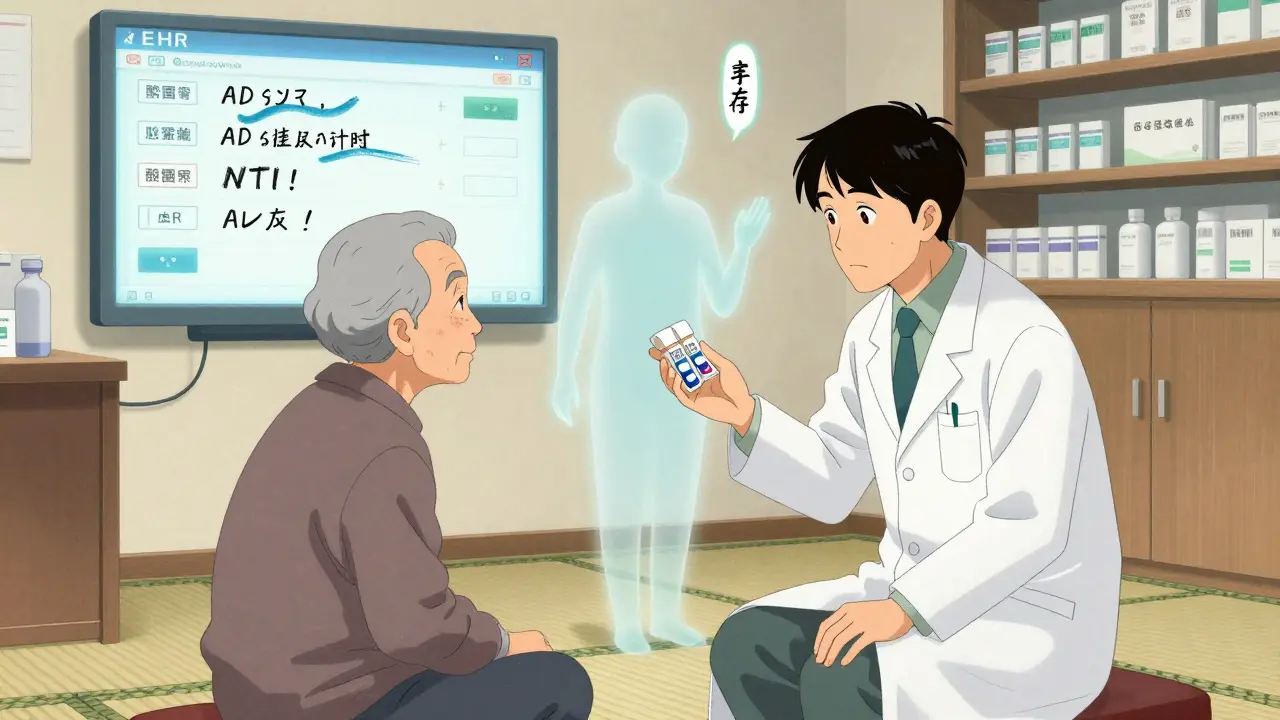
Seventeen states have extra rules for Narrow Therapeutic Index (NTI) drugs. These are medications where even tiny changes in blood levels can cause toxicity or treatment failure. Warfarin is the classic example. A patient’s INR can swing dangerously if they switch from one generic manufacturer to another-even if both are FDA-approved.
In these cases, documentation isn’t just about what was dispensed. It’s about why. Did the prescriber approve the switch? Did the patient report any new symptoms after the change? Was the substitution made due to insurance pressure or clinical judgment? One 2021 case in the Journal of the American Pharmacists Association documented a patient hospitalized after a generic warfarin switch because the pharmacist didn’t note the change in the chart. The prescriber didn’t know. The patient didn’t know. The INR wasn’t checked for weeks.
Electronic Systems and Real-World Challenges
Most pharmacies use electronic systems now. But not all systems are built the same. Epic Systems reported in 2023 that 32% of pharmacies using their platform needed custom tweaks just to meet state documentation rules. That’s a lot of extra work for IT teams and pharmacists alike.
Time is another factor. Pharmacists report adding 20 to 30 seconds per prescription just to log substitution details. That adds up-especially during busy hours. But here’s the flip side: a 2022 study across 150 community pharmacies showed that thorough documentation reduced medication errors by 17.3% in six months. That’s not just a number. That’s fewer ER visits, fewer hospital stays, fewer lives disrupted.
Who’s Responsible for What?
The FDA says generics are interchangeable. The World Medical Association says: not so fast. Their 2023 update recommends that once a patient is stable on a drug-brand or generic-no substitution should happen without the prescriber’s permission. That’s especially true for chronic conditions like epilepsy, heart failure, or psychiatric disorders.
Prescribers also have a role. The American Medical Association recommends that doctors document when they prescribe a brand-name drug for medical necessity. That way, pharmacists know not to substitute. If a doctor writes “Dispense as written” or “Do not substitute,” that’s legally binding in most states. But if they don’t, and you substitute without documenting it, you’re the one on the hook.
What Happens If You Don’t Document?
Ignoring documentation isn’t just sloppy-it’s risky. In 2022, the American Pharmacists Association survey found that 68% of pharmacists saw documentation as moderately burdensome. But 23% said they’d prevented an adverse event because they caught a mismatch in the records. That’s the difference between a near-miss and a tragedy.
Insurance companies audit claims. If your documentation is incomplete, they’ll deny payment. State boards of pharmacy investigate complaints. If a patient has a bad reaction after a substitution, your lack of records could be seen as negligence. And in court, if you can’t prove you documented the change, the law assumes you didn’t do it.
How to Stay Compliant in 2026
Here’s how to get it right every time:
- Know your state’s laws. Use the National Community Pharmacists Association’s online tool-it’s updated quarterly.
- Set up your pharmacy system to auto-populate substitution fields. Don’t rely on manual entry.
- For NTI drugs, always check if the prescriber has flagged the prescription as “do not substitute.” If not, get patient consent and document it.
- Record the substitution within 24 hours. Forty-one states require this deadline.
- Train new staff. It takes 4-6 weeks for a new pharmacist to fully grasp state-specific rules.
- Review your records monthly. Spot-check a sample of substitution logs. Fix gaps before an audit finds them.
The Bigger Picture: Why This Matters
Generic drugs saved the U.S. healthcare system $1.69 trillion between 2013 and 2022. That’s huge. But that savings only works if substitutions are safe and traceable. The Congressional Budget Office estimates that standardized documentation rules could save $4.2 billion a year by cutting down on adverse events.
And it’s not just about money. It’s about trust. Patients rely on pharmacists to know what they’re taking. Prescribers rely on pharmacists to alert them when something changes. Insurance companies rely on accurate records to pay claims. When documentation is poor, the whole system wobbles.
As of 2026, 12 states have already adopted the Model State Pharmacy Act’s uniform documentation standards. More will follow. The FDA’s GDUFA III rules now require manufacturers to submit more detailed bioequivalence data. Blockchain pilots are reducing documentation errors by 22%. The future is moving toward seamless, real-time, auditable records.
Being compliant isn’t about checking boxes. It’s about protecting people. Every time you document a substitution, you’re not just filling out a form. You’re writing a safety net.
Do I need to document generic substitutions if the prescriber didn’t specify brand or generic?
Yes. Even if the prescription doesn’t say “Dispense as written,” you’re still required to document any substitution you make. In most states, the default is that substitution is allowed unless the prescriber says otherwise. But you must record what you dispensed, who approved it, and when. Failing to document doesn’t make the substitution legal-it just makes you liable.
Can I substitute a generic without telling the patient?
In 27 states, yes-you can substitute without explicit consent. But you still have to document the change. In 14 states, you must get verbal or written permission from the patient. In the remaining nine, consent is required for high-risk drugs like warfarin or lithium. Even in states where consent isn’t legally required, best practice is to inform the patient. Many patients assume they’re getting the same drug they’ve always taken. If they notice a different pill shape or color, they may stop taking it. A quick explanation prevents confusion and improves adherence.
What if the generic manufacturer changes mid-prescription?
Each time you dispense a different manufacturer’s version-even if it’s the same generic-you must document the new lot number, manufacturer, and expiration date. This isn’t just bureaucracy. Different manufacturers can have slight variations in inactive ingredients or release profiles. For NTI drugs, this can matter. The FDA doesn’t track these changes at the national level, so the responsibility falls to the pharmacist. Failing to update the record could mask a source of adverse effects later on.
Do I need to document substitutions for Medicare Part D patients?
Yes. Medicare Part D requires clear documentation of substitution, including the manufacturer name and the fact that a substitution occurred. CMS audits these records to prevent fraud and ensure proper payment. If your records are incomplete, the claim will be denied-and you may be held responsible for the cost. Many pharmacies use automated flags in their systems to ensure Part D substitutions are tagged correctly.
How long do I need to keep substitution records?
Most states require records to be kept for at least two years, but some require up to five. The National Association of Boards of Pharmacy recommends keeping them for five years to cover potential legal or audit timelines. Electronic records should be backed up and stored securely. Paper records should be locked and dated. Never destroy records before the required retention period ends-even if the patient no longer uses the medication.
What’s Next?
The push for national standardization is gaining speed. The ASPE is drafting federal guidelines expected in mid-2024. If adopted, they could cut through the current patchwork of 50 different rules. Until then, staying compliant means knowing your state’s law, using your system well, and never assuming a substitution is too small to document. In pharmacy, the smallest detail can be the most important one.

Darren Ramowski
My name is Calem Goodridge, and I am a pharmaceutical expert with a passion for educating others about medication and diseases. I have dedicated my career to researching and developing life-changing medical treatments. In my spare time, I enjoy writing articles and sharing my knowledge with the general public to help them make informed healthcare decisions. I am also an advocate for safe medication practices and believe that patient education is key to preventing adverse drug events. With my extensive experience in the pharmaceutical industry, I strive to make a positive impact on the lives of others through my writing.
Look, I get the paperwork. But let’s be real-half the time, the patient doesn’t even know what’s in the pill. I’ve seen people get mad because their ‘brand’ changed color, even though it’s the same damn drug. Documentation doesn’t fix that.
Y’all in the US really overthink this. In Lagos, we just give the cheapest thing that works. If the patient feels different, they come back. Simple. No forms. No audits. Just care.
The philosophical underpinning here is not compliance-it is accountability. When a pharmacist dispenses a substitute, they assume a fiduciary duty beyond the transactional. The record is not a bureaucratic artifact; it is the moral trace of clinical responsibility.
Okay but have you ever tried explaining to a 72-year-old why their heart med now looks like a blue jellybean?? I cried once after a patient yelled at me because ‘the doctor gave me the white one’-and I had documented everything. It’s not the paperwork that’s broken-it’s the system.
People who don’t document substitutions are literally endangering lives. If you’re too lazy to type five fields, you shouldn’t be handling prescriptions. This isn’t a suggestion-it’s a moral minimum. And yes, I’ve seen the hospitalizations. I’ve seen the obituaries.
Pro tip: If your pharmacy system doesn’t auto-fill manufacturer + lot #, you’re doing it wrong. I’ve got a template in my notes: Brand: ___, Generic: ___, Mfr: ___, Lot: ___, Exp: ___. Print it. Tape it to your monitor. Do it. Every. Time.
I appreciate the depth of this analysis. The tension between cost-efficiency and clinical fidelity is real, and the data presented supports a nuanced approach. I wonder, however, whether the burden on frontline staff might be mitigated through interoperable EHR standards across state lines.
My boss says if we don’t document, we get fined. I say if we don’t document, someone dies. So I document. Even when I’m tired. Even when the line is out the door. It’s not optional.
WHY IS THIS EVEN A CONVERSATION?!?!? We’re talking about PEOPLE’S LIVES here. One wrong substitution, one missing lot number, and someone’s kidney fails. And you want to cut corners because it’s ‘too much paperwork’? That’s not negligence-that’s negligence with a side of arrogance.
Record everything. Keep it for five years. Back it up. Check it monthly. Train new people. That’s the job. No drama. No excuses. Just do it.
THIS. IS. CRUCIAL. I used to think it was busywork. Then my best friend had a seizure because her epilepsy med switched manufacturers and no one documented it. She’s fine now. But I will never, ever stop yelling about this.
i mean... like... we’re all just trying to get through the day, right? and sometimes you’re just so tired, and the system glitches, and you forget to type the lot number... and then you’re like... is this gonna kill someone? and you cry... and then you do it again tomorrow...