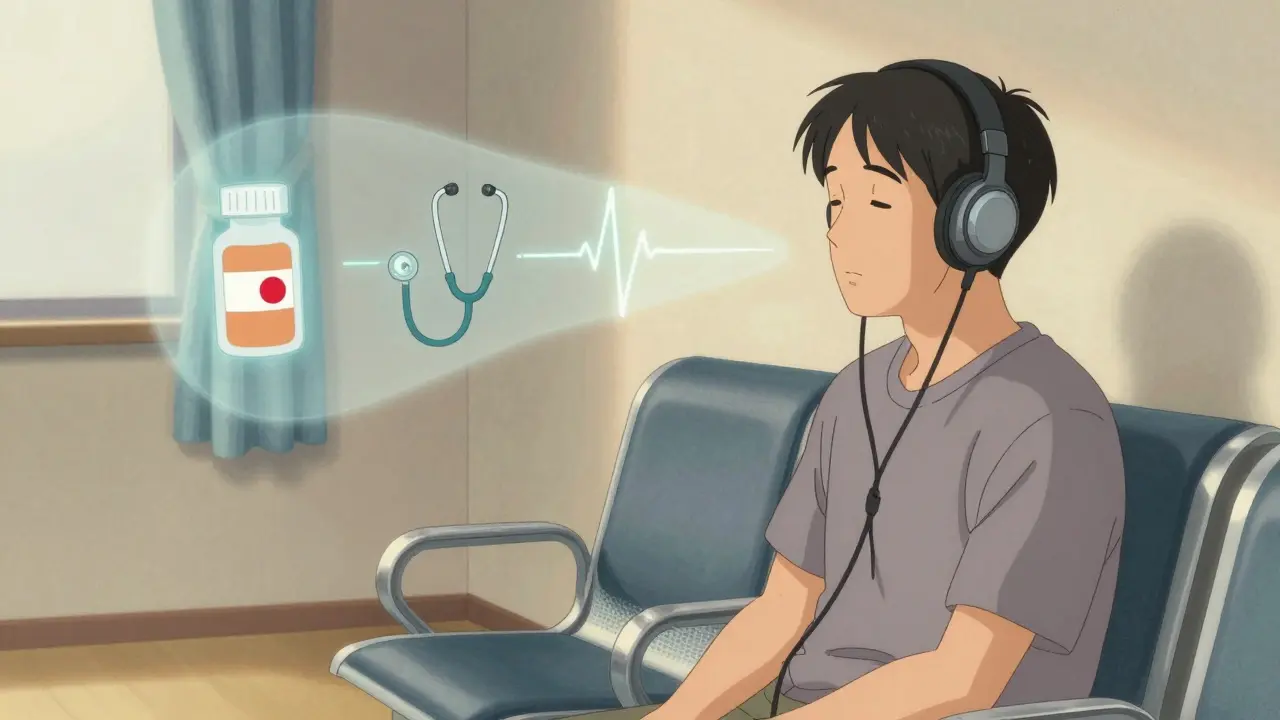
Imagine trying to understand your new diabetes medication when every instruction is printed on paper you can’t read. Or walking into a hospital for the first time, lost in a maze of hallways with no signs you can see. For millions of people with vision loss, this isn’t hypothetical-it’s daily reality. But it doesn’t have to be. Audio resources are changing how visually impaired patients access healthcare information, giving them control, safety, and independence.
Why Audio Matters in Healthcare
Healthcare isn’t just about pills and procedures. It’s about understanding what’s happening to your body, knowing when to take your meds, recognizing warning signs, and navigating the system. When that information is locked behind visual formats-paper forms, digital screens, printed labels-visually impaired patients are left behind. Studies show these patients are 2.3 times more likely to make dangerous medication errors when audio alternatives aren’t provided. That’s not a minor risk. That’s life-threatening.
The good news? Federal laws like the Americans with Disabilities Act and the Affordable Care Act require healthcare providers to offer accessible communication. That means audio is not a luxury-it’s a legal obligation. And it’s not just about compliance. Facilities that use audio resources see 28% higher satisfaction from visually impaired patients. Better communication means fewer missed appointments, fewer errors, and fewer hospital readmissions.
Free Audio Tools You Can Start Using Today
You don’t need to spend a dime to get started. Several free, high-quality audio tools are already available to patients and caregivers.
- NLS BARD Mobile from the National Library Service for the Blind gives you free access to over 120,000 audiobooks, including medical guides on diabetes, heart disease, and mental health. It works on iOS and Android, and you can download content to use offline-perfect for areas with poor signal in clinics.
- CRIS Radio offers live-streamed health programs and recorded patient education content from trusted sources like the CDC and Mayo Clinic. No app download needed-just tune in via web browser.
- Braille Institute’s Audio Library partners with NLS to deliver specialized medical content. You’ll need to complete a simple certification process to prove eligibility, but once approved, you get unlimited access at no cost.
These aren’t just audiobooks. They’re structured, medically reviewed, and designed for clarity. For example, one audio module on insulin use walks you through injection steps, storage tips, and what to do if you miss a dose-all spoken slowly, clearly, and without background noise.
Paid Tools That Go Beyond Basic Audio
If you need more than just listening to content, some paid tools offer powerful features that make daily life easier.
- Voice Dream Reader ($29.99) turns any text-emails, PDFs, hospital letters-into spoken words. It supports over 100 voices and 30 languages. You can scan a printed prescription with your phone’s camera, and it reads it aloud instantly. No more asking a nurse to interpret handwriting.
- KNFBReader ($99) is even more precise. It reads printed text with 98.7% accuracy in under three seconds. It’s especially useful for reading lab results, insurance forms, or medication labels that aren’t available digitally.
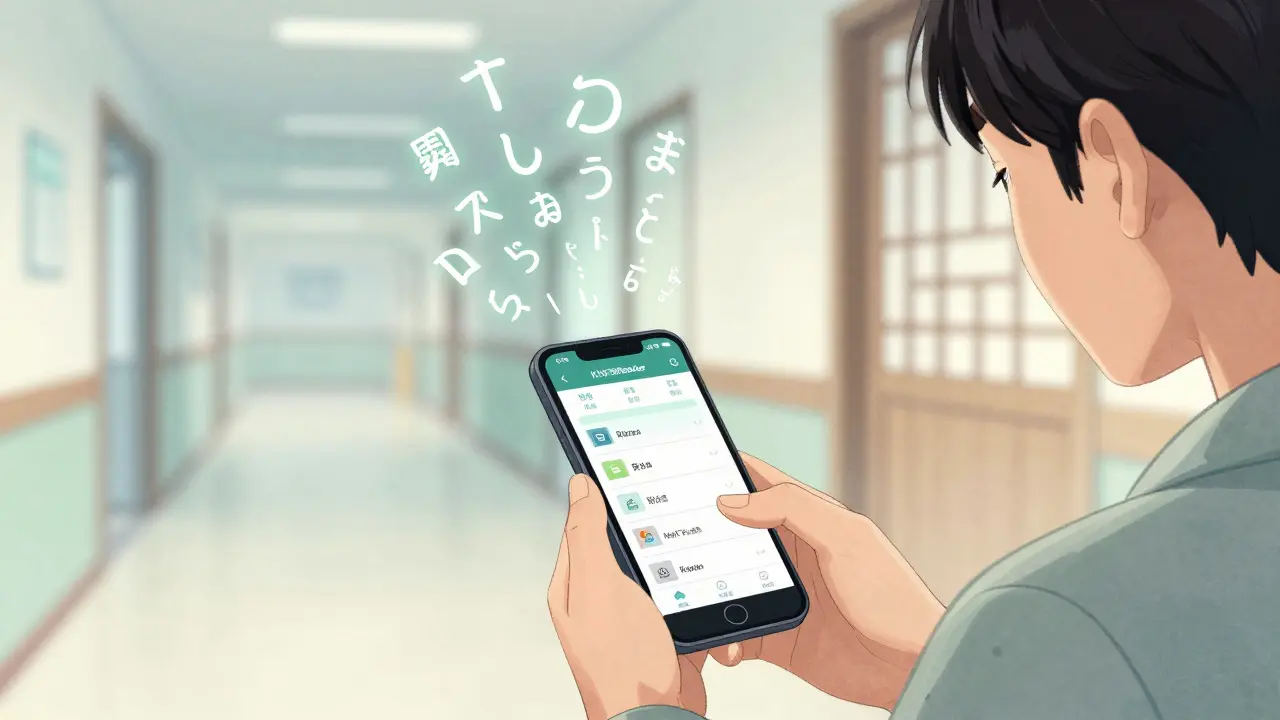
- RightHear Talking Signage isn’t an app you install-it’s a system built into hospitals. Using Bluetooth beacons, it guides you room-by-room with spoken directions: “Turn left toward the lab. Next stop: Cardiology waiting area.” Hospitals using this system report 47% fewer requests for staff assistance.
These tools aren’t gimmicks. They’re lifelines. A patient in New York used KNFBReader to read her biopsy report when the clinic hadn’t provided an audio version. She caught a critical error in dosage instructions and called her doctor before it was too late.
What Hospitals Should Be Doing (But Often Aren’t)
Not every hospital is doing its part. A 2024 survey found that 63% of visually impaired patients faced inconsistent access to audio materials across different providers. Some clinics offer audio recordings on request. Others don’t even know they’re required to.
Here’s what effective implementation looks like:
- Every patient intake form has an audio option-no need to ask.
- Appointment reminders are sent as audio files, not just texts or emails.
- Waiting rooms play looping audio summaries of common procedures.
- Staff are trained to say, “Would you like this information in audio format?” not, “Do you need help reading this?”
St. Jude’s Hospital rolled out a custom system called VisionConnect™. Within months, patient confusion dropped from 67% to 12%. That’s not magic-it’s intentional design.
But many hospitals still rely on outdated methods: a single cassette recorder, low-quality recordings, or audio files that won’t play on modern screen readers. One 2023 study found 17% of hospital-provided audio files failed basic accessibility tests. That’s unacceptable.
What’s Changing in 2024 and Beyond
The landscape is shifting fast. Thanks to the 21st Century Cures Act, all electronic health record systems in the U.S. must include audio output by December 2024. That means your doctor’s notes, lab results, and discharge instructions will be available as audio by default.
Also in 2024, the NLS expanded its medical audio library by 37%. New titles cover rare conditions, mental health management, and navigating Medicare. Meanwhile, Mayo Clinic is testing AI-powered audio summaries that condense a 10-page medical report into a 90-second spoken overview-personalized to your condition and questions.
By 2025, CMS plans to require all facilities to offer real-time audio translation for non-English speaking visually impaired patients. That’s huge. It means a Spanish-speaking patient with low vision won’t have to rely on a child or untrained staff to explain their diagnosis.

How to Get Started
If you’re visually impaired and struggling to access health information, here’s what to do right now:
- Download BARD Mobile from your app store. Sign up through your local Braille Institute or NLS office. It’s free and takes less than 10 minutes.
- Ask your doctor or clinic: “Do you offer audio versions of your patient materials?” If they say no, ask for a copy of their accessibility policy.
- If you need help reading printed documents, try Voice Dream Reader or KNFBReader. Both offer free trials.
- Request audio appointment reminders. Most clinics can email or text a link to an audio file.
- Join online communities like Reddit’s r/Blind. Other patients share tips on which hospitals have good audio systems-and which ones don’t.
Don’t wait for someone to offer help. Advocate for yourself. You have rights. And you deserve to understand your health without barriers.
Common Problems and How to Fix Them
Even with good tools, issues come up. Here’s how to handle the most frequent ones:
- “The audio file won’t play on my phone.” Check if it’s in MP3 or WAV format. If it’s a .wma or .aac file, ask for a different format. Most screen readers don’t support those.
- “The voice sounds robotic and hard to follow.” Use Voice Dream Reader or BARD Mobile-they let you pick from dozens of natural-sounding voices. Switch to one that feels comfortable.
- “The hospital doesn’t have audio for my test results.” Request it in writing. Under federal law, they have 10 business days to respond. If they don’t, file a complaint with the Office for Civil Rights at HHS.gov.
- “I’m not tech-savvy.” Ask a family member, friend, or local library staff to help set up BARD Mobile. Many libraries offer free tech help for seniors and people with disabilities.
Audio isn’t about replacing human help. It’s about giving you the tools to be independent when you need to be.
Are audio resources really required by law?
Yes. Under the Americans with Disabilities Act (ADA) and Section 504 of the Rehabilitation Act, healthcare providers must offer auxiliary aids-including audio recordings-to ensure effective communication. This applies to all facilities receiving federal funding, which includes nearly every hospital and clinic in the U.S.
Can I get audio versions of my medical records?
Absolutely. The 21st Century Cures Act requires electronic health record systems to provide audio output by December 2024. Even before that, you can request audio versions of your records under HIPAA. Providers must comply within 30 days. If they refuse, file a complaint with the U.S. Department of Health and Human Services.
What if my doctor says they don’t have the budget for audio tools?
Budget isn’t a legal excuse. Federal law doesn’t allow cost to override accessibility. If a provider claims they can’t afford it, ask for their written accessibility policy. You can also contact your state’s Protection and Advocacy agency-they help patients enforce their rights at no cost.
Are there audio resources for non-English speakers?
Yes. BARD Mobile and Voice Dream Reader support over 30 languages. Many nonprofit groups, like the National Federation of the Blind, offer multilingual medical audio guides. Starting in 2025, CMS will require all healthcare facilities to provide real-time audio translation for non-English speaking visually impaired patients.
How do I know if a hospital is truly accessible?
Ask three questions: Do they offer audio versions of all patient materials by default? Do staff know how to use screen readers? Is there a working audio wayfinding system? If they hesitate or say “we can make one,” that’s a red flag. Hospitals with strong accessibility programs, like Johns Hopkins and St. Jude’s, list their tools and contacts openly on their websites.
What Comes Next
The future of accessible healthcare isn’t just about better audio. It’s about systems that expect you to need it-and deliver it without you having to ask. AI summaries, real-time translation, and seamless integration with EHRs are coming fast. But right now, the power is in your hands. Download BARD Mobile. Ask for your records in audio. Tell your doctor you need it. You’re not asking for special treatment. You’re asking for the same access everyone else already has.

Darren Ramowski
My name is Calem Goodridge, and I am a pharmaceutical expert with a passion for educating others about medication and diseases. I have dedicated my career to researching and developing life-changing medical treatments. In my spare time, I enjoy writing articles and sharing my knowledge with the general public to help them make informed healthcare decisions. I am also an advocate for safe medication practices and believe that patient education is key to preventing adverse drug events. With my extensive experience in the pharmaceutical industry, I strive to make a positive impact on the lives of others through my writing.
Just downloaded BARD Mobile on my phone last week-life changed. My aunt in Delhi has glaucoma and now she listens to her blood pressure tips while making chai. No more asking neighbors to read labels. India’s got so many blind folks, and yet hospitals still think paper is fine. Time to wake up.
Wow. Another ‘accessible tech’ article. Next you’ll tell me oxygen is a human right. I mean, sure, I’m glad some people can finally hear their prescriptions instead of squinting at them. But let’s be real-this is just corporate virtue signaling with a side of ADA compliance. The real problem? Nobody’s fixing the fact that half the population can’t afford a phone that doesn’t die in 2 hours.
How quaint. We’ve moved from braille to audio, as if language itself were a mere binary toggle. The real tragedy isn’t the lack of MP3s-it’s the institutionalized infantilization of the visually impaired. You don’t need a voice synthesizer to tell you how to take insulin. You need a society that doesn’t treat disability as a logistical inconvenience to be outsourced to an app. But no, let’s just hand out free audiobooks and call it justice. How very… 2024.
This is so helpful! 😊 I showed this to my cousin who’s blind and he’s already using Voice Dream Reader to read his insurance letters. He said the voice options are way better than the robotic one his clinic gave him. Also, KNFBReader sounds like magic-wonder if it works with Indian rupee notes? 🤔
Stop pretending this is a breakthrough. 63% of hospitals still don’t comply? That’s not a gap-it’s negligence. And you list free tools like they’re charity gifts. People aren’t asking for ‘free resources.’ They’re asking for their legal rights. The fact that you have to Google this stuff means the system is broken. And no, ‘download BARD Mobile’ isn’t a solution. It’s a Band-Aid on a hemorrhage.
Let’s contextualize this within the healthcare accessibility framework. The ADA mandates auxiliary aids, but implementation fidelity remains low due to fragmented EHR interoperability and non-standardized audio output protocols. The NLS BARD Mobile integration is commendable, yet lacks API-level compatibility with institutional CMS systems. Without HL7 FHIR audio extensions, we’re just optimizing the surface layer of a deeply flawed infrastructure.
Wow, so we’re now celebrating that hospitals aren’t actively violating the law? That’s the bar now? Congrats, we’ve lowered the ceiling so far it’s below ground level. And you think telling people to ‘ask for audio’ is empowerment? No. It’s placing the burden of compliance on the disabled. The system should just… work. Like, automatically. Like it does for sighted people. Why is that so hard?
Man, this is good. I’m from Nigeria and we don’t have much here, but my sister uses BARD Mobile on her old phone. She says it’s the first time she felt like a patient, not a problem. We need more of this. Not just in the US. Everywhere.
Okay so let me get this straight-you’re telling me that people with vision loss are supposed to just download apps and magically get their meds explained? What about the elderly? What about people who can’t afford smartphones? What about those who don’t trust tech because their grandpa got scammed by a ‘free audio doctor’ scam? You’re ignoring the real-world chaos. And don’t even get me started on how many of these ‘audio files’ are just .wav files with 10 seconds of silence and then a voice whispering ‘take pill’ like a haunted answering machine.
Why is no one talking about how disgusting it is that we’re still at this point? That people have to beg for audio versions of their own medical records? That’s not accessibility-that’s humiliation. And you call this a ‘guide’? It’s a cry for help dressed up as a blog post. And the fact that you think ‘ask your doctor’ is a solution? That’s not advice. That’s cruelty. I’m done.
This post is just fluff. Nobody cares.
Think about it: we live in a world where AI can generate poetry, predict cancer from X-rays, and compose symphonies-but we still need a 29-dollar app to read a prescription? That’s not innovation. That’s failure on a civilizational scale. We’ve built rockets to Mars but can’t make a hospital form speak clearly. We’ve outsourced empathy to software because it’s cheaper than training staff. And now we pat ourselves on the back for ‘free audio tools’ like we’ve solved poverty. We haven’t. We’ve just made the invisible a little less silent. And that’s not enough. Not even close.
I love how you included the part about asking for audio versions-so simple but so powerful! 😊 My mom’s diabetic and she’s been using BARD Mobile for months now. She says it feels like someone finally said ‘I see you.’ And honestly? That’s everything. Thank you for writing this.
From a clinical informatics perspective, the integration of audio output into EHRs under the 21st Century Cures Act represents a critical milestone in patient-centered design. However, without standardized metadata tagging for audio content (e.g., speaker role, pacing, semantic segmentation), interoperability remains fragmented. The real challenge lies not in distribution, but in semantic fidelity. Audio must be structured-not just spoken. Otherwise, we risk creating a new class of accessibility theater.